Manila: Construction and Handling of a Changing Envelope
A card placed into an envelope visually changes into the one chosen by the spectator. Julio Montoro presents Manila, demonstrates a card version, and teaches how to build the changing envelope and perform the full handling.
Montoro goes through the construction using an envelope, an auxiliary card, elastic thread, and adhesives, before moving on to the presentation of the change.
Building the Mechanism and Adjusting the Envelope
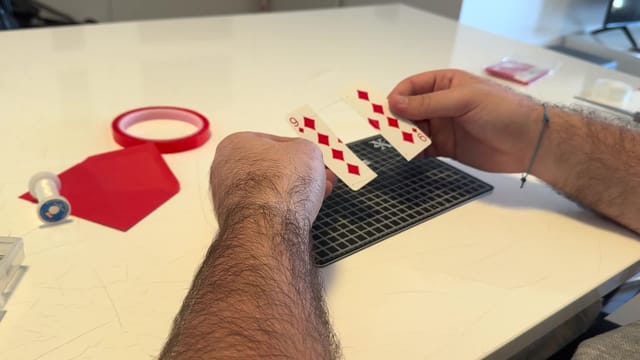
The tutorial shows how to prepare an auxiliary card and adapt it to the size of the envelope. It works with an envelope where the card fits snugly, so that the dimensions of the material and the assembly are compatible.
The cutting, punching, and placement of the elastic thread are explained. The clear tape used to keep the pieces aligned during part of the manufacturing serves a different purpose than the double-sided tape in the final assembly.
Julio tests the operation before finishing the construction and shows how to insert and secure the assembly inside the envelope. He also explains a correction to prevent the edge of a piece from rubbing or jamming during movement.
That testing and adjustment are part of the workshop. The explanation does not just stop at showing the finished envelope.
Preparing the Deck and Controlling the Selection
The routine requires a reference card in the deck that matches the one used in the mechanism. The back of the auxiliary piece does not have to be the same color, because it is used inside the assembly.
Shuffles that preserve the necessary position are taught, and the selection of a card is developed. Julio explains the double lifts and breaks used to keep the chosen card while it appears to be lost in the deck.
The tutorial reviews the sequence with different values. The nine of diamonds and the cards chosen in the examples make it easy to follow the explanation, but they are not mandatory values for the effect.
The Transformation Inside the Envelope
It covers how to show the card that is seemingly inserted, place it into the envelope, and coordinate the handling to present the change. The angles relative to the spectator and the continuity between one action and the next are part of the explanation.
Julio shows the transformation of one card into another. He also mentions changes with banknotes and the possibility of using a signed card; those possibilities expand the use of the tool, but the routine developed in the video is the card version.
Materials and Practice
You need an envelope suited to the size of the cards, a deck, and an extra card of the same value as one in the deck, double-sided tape, clear tape, scissors, an awl, elastic thread, and a needle. The tutorial uses a cutting mat and discusses the use of a thimble during manufacturing.
These are materials to build the envelope, not a list of branded magic products. The construction and preparation are done before performing.
It is helpful to have a foundation in card handling to work on the shuffles, breaks, and doubles applied to the routine. Practice the operation of the envelope first and then the card sequence, before bringing both parts together in the presentation.