Magical Atmosphere: Attention, Cover, and Necessary Actions
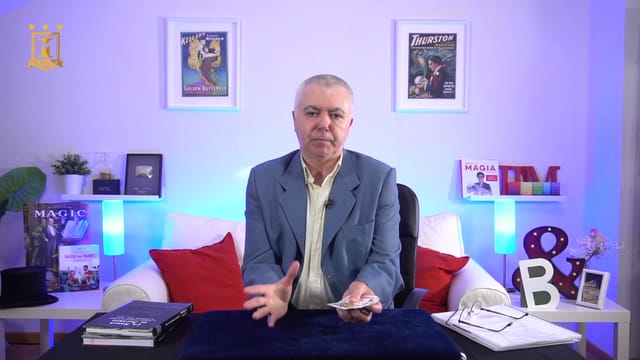
Card sleights require a construction that gives them meaning in front of the audience. Miguel Gómez explores how to combine moves, patter, and spectator participation so that secret actions do not weaken the sense of impossibility. The palm serves as the primary example of a theory that can be applied to other routines.
The Fragility of the Magical Atmosphere
The explanation stems from Arturo de Ascanio's concept of the magical atmosphere: the spectator knows they are witnessing illusionism, but during the performance, they find no clues that continually draw them back to searching for the method. The first sign of something extraordinary should arrive with the effect.
We examine why an overly visible pinky break, a tense hand, or an isolated move can arouse suspicion even if they do not reveal the method. The issue is not merely hiding a maneuver, but maintaining the naturalness of the whole. Sleight of hand, looseness, nonchalance, patter, and timing all play a part in this construction.
Gómez presents the theory as a tool to study and improve your work. He also explains that it can be adapted to a personal style, always starting from an understanding of its functions and consequences.
Necessary Actions and Cover
The instructor distinguishes his analysis of necessary actions from Ascanio's concepts. He proposes taking advantage of what must already happen within the trick, or what the audience expects to happen, to integrate a technical action without introducing arbitrary gestures.
One example uses gathering spread cards from the table. The collaboration of a participating spectator creates a wide movement with which to coordinate the cut and the replacement from the palm. That solution is contrasted with performing the maneuver first under the full attention of the audience and asking for the gathering afterward.
The analysis includes the words accompanying the action and how they help remember who handled the cards. Cover is added to worked-on technique; it does not replace its precision.
Priority Movement and Body Coordination
The order in which the hands begin to move, the direction of the gaze, and the relationship with the participant are studied. If the hand needing discretion initiates the movement alone, it can draw attention to itself. A well-motivated primary action allows a secondary one to be placed in the background.
Examples show how to accompany this coordination with the body, move around, and leave room for spectator intervention. The law of priority movement is presented as a tool to organize this choreography, which must be practiced until it becomes fluid.
Initial Setup, Magical Moment, and Effect
The structure of the routine is analyzed as a contrast between two situations, bridged by a magical moment. The initial setup needs to be clear so the audience can later appreciate the transformation.
An example with two groups of five cards allows us to study what is best to show and remember before the effect. Counting out of routine is distinguished from counting to emphasize a relevant condition. Afterward, that clarity must be maintained: the magical gesture should look innocent, and pauses or jokes should not offer an alternative explanation for what happened.
The class examines how spectator participation and continuity reminders allow humor to be introduced without losing the established conditions. Fragments from "Nunca seis" and the heaps trick serve as case studies; they are not developed as full routines.
Courtesy, Actions in Transit, and Context
A greeting serves to study a card addition integrated into an action in transit. Yielding passage or a seat allows the analysis of another cover, applied to a Charlier cut. In both cases, the interaction has a valid reason within the trick and respects the spectator's genuine role.
The physical cover is distinguished from the psychological justification of the action. Audience habits also matter: a gesture must feel coherent within the context of the performance. If there is no necessary action available, the proposal is to build a new logical necessity within the presentation.
Materials and Practice
To reproduce the examples, you can use a standard deck, a table, and the help of another person. You should be familiar with the palm, replacing from the palm, and basic packet handling; the class analyzes their cover without teaching all the mechanics from scratch. The Charlier cut is also shown as an application, not as a standalone tutorial.
The suggested approach is to start with a simple routine you already master: identify its initial conditions, review what actions it needs, and coordinate attention, movements, and patter. Afterward, you can apply this analysis to more complex handlings. Ascanio's book appears as the instructor's reference; it is not provided as included material or mandatory reading.