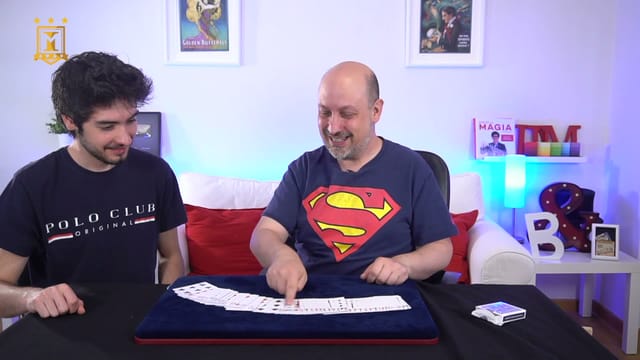
Memorized Deck: Choosing the Stack and Card-Number Associations
A memorized deck links every card to a specific position, and every position to a card. Woody Aragón introduces this tool, compares different stacks, and breaks down a mnemonic system to start learning the first 26 cards. The work is done with examples, drawings, and questions in both directions.
What Gets Memorized
The explanation draws a line between a memorized deck and an algorithmic stack like Si Stebbins. In the former, the goal is to instantly recall the card-number relationship without having to rebuild the whole sequence or run through a formula every time you need a position.
The alphabet example helps make this distinction clear: knowing the list from the beginning doesn't mean you can instantly jump to a spot in the middle. You practice both finding the number of a card you're looking at and naming the card when someone calls out a number.
The opening performance shows off various uses: weighing the deck by feel, divination of a chosen card, locating a named card, and a poker demonstration. These examples show the scope of the tool; the hands-on teaching in this class focuses on choosing a stack, memorizing it, and a basic divination routine.
Choosing a Stack
We weigh the pros and cons of learning a random order versus choosing a stack that already has built-in properties useful for certain tricks. The Aronson, Tamariz, and Memorandum stacks are discussed, with the latter being Woody's go-to for his demos.
A memorized deck is the general concept; the Tamariz stack is just one specific order among those mentioned. The poker properties or position highlights in the Memorandum examples belong exclusively to that stack and won't automatically carry over to another stack you might choose.
Starting with 26 Cards
Studying just one half of the deck is suggested to make learning more manageable and leave the other half free for mixing in certain routines. We break down the freedom this gives you and why it's smart to clearly separate the cards you're currently learning from the rest.
Getting ready means writing down the stack order and setting up your deck to match that list. Next, you build your own personal association between the number and the identity of each card. Numbers can be tied to personal experiences or mental images; your sketch should also keep the index and suit so you don't just remember half the info.
The examples feature the Jack of Spades tied to the number one and the Ace of Diamonds tied to the four in the stack being used. A student comes up with their own image, and the teacher checks which elements help them recall the connection. The point isn't to copy the teacher's drawings word-for-word, but to build associations that click for you.
Testing and Reinforcing Recall
We bounce back and forth between number-to-card and card-to-number questions. The goal during testing is instant access, not reciting the whole stack from card one until you hit the requested position.
For stubborn associations, we use the trick of adding a phrase or a more detailed scene. Combining the image, number, suit, and storyline lets you spot what's missing and nail it down. The plan is to finish the work with all 26 cards, paying extra attention to the ones that take a second longer to pop into your head.
As an application, a chosen card divination is explained, taking advantage of the relationship between consecutive positions. This routine also doubles as a solid drill for practicing the back-and-forth between identity and number.
Materials and Preparation
You'll need a standard deck of cards, the list of the stack you've decided to learn, a notebook, and a pen or pencil for drawing and writing. The numbered deck used in the demos is a teaching aid, not a mandatory buy.
You don't need to know a mnemonic system already to dive into this method. It's best to work without interruptions and test both directions of every association. For the divination routine, it helps to have basic card handling skills and be able to secretly peak at a card's info. Learning is set up as a personal practice, without setting the exact same memorization timeline for everyone.