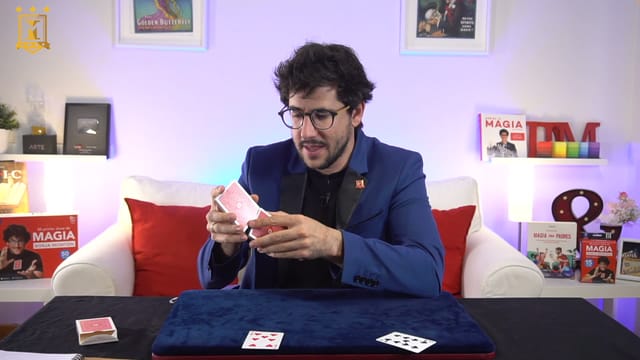
Svengali Deck: forces, cross divination and ambitious card
The Svengali deck allows you to build different routines from the exact same principle. Borja Montón breaks down its setup, ways to offer a card, and the maintenance it needs during a performance. The initial demonstration serves as a starting point to explain a multi-phase routine and review how to present this deck naturally.
Mechanics and Setup
He explains the relationship between short and long cards, the alternating layout and the importance of preserving it during handling. Borja shows how to separate the two groups, rebuild the deck, and recognize when a card has slipped out of place.
The setup can start with a ready-made Svengali deck. He also discusses building one yourself using identical cards from a force deck, trimming and rounding the corners. The trim size reference is approximate; the main takeaway is testing that the whole pack works smoothly.
Forces and Spectator Participation
The force is worked through a riffle cascade in the hands, a riffle cascade on the table, a riffle and cuts. Both the magician's actions and how to instruct the spectator where to hold and cut are examined. Deck orientation matters: different grip points do not necessarily produce the same result.
Another option involves the spectator dealing cards and stopping. Here, we analyze how to recognize the resulting state and how to reset the pack after the choice. It is not enough just to offer a card; you must maintain the conditions needed to continue.
Troubleshooting comes up during the demos. We cover card slippage within the packet, the loss of tactile reference, and spotting two misplaced cards. These adjustments are all part of learning the handling.
Natural Displays and Shuffles
Borja compares the usual card-fall display with a looser riffle cascade. He suggests practicing first with a regular deck to avoid tension in your hands or exaggerated movements when using the gimmicked deck. He also shows a ribbon spread across the table followed by a wave turnover, for which a good close-up mat comes in handy.
The shuffles section includes an optical shuffle and a riffle shuffle working with pairs. We distinguish between the look of a shuffle and the conditions that actually preserve the stack. The deck requires specific handling: being able to shuffle doesn't mean you can freely alter any part of the order.
Cross Divination, Ambitious Card and Transposition
The routine starts with two packets and two chosen cards swapping groups. After the shuffles, the magician finds both selections. He explains the specific setup for this first phase, how the packets are displayed, and interaction options with one or two spectators. The instructor discusses the difference between masking certain sleights on camera versus performing live.
The continuation uses a faro shuffle to get into the stack required for the Svengali. He shows how to spot and correct an imperfection in the weave, meaning a perfect faro isn't mandatory. You just need to understand the layout that must be in place before moving on.
One of the cards is placed under the card case, and the other stars in an ambitious card sequence: it jumps back to the top and incorporates a visual drop-off production. The finish ties into a transposition between the card in the deck and the one under the case. The explanation highlights remembering the initial situation and pausing to let the change sink in.
Top change is used within this sequence, without a detailed breakdown of its mechanics. Potential appearances elsewhere are mentioned as personal choices rather than fully developed additional routines.
Variants and Presentation Choices
He demonstrates a location using packet selections with a real or imaginary die, and applying a chosen card to a numerical position. The latter relies on a conditioned choice and parity management; it doesn't offer a freely named card at any position under identical conditions.
He also analyzes the apparent transformation of all cards into the chosen one. Borja explains why he prefers to skip this in his own routine, even though he acknowledges its visual punch. The final comparison with the Mirage or Miracle deck covers the advantages of rough and smooth for showing cards and the tactile differences when letting a spectator handle the deck.
Materials and Practice
You will need a Svengali deck, its card case, and a close-up mat to run through the entire sequence. A regular deck works for practicing the riffle cascade; the die and the Mirage deck are for optional applications and comparisons. He discusses finish and size differences, including the bridge size option for smaller hands, without requiring any specific brand.
You should be comfortable with cuts, riffle cascade, riffle shuffle, faro and top change. Basic forces can be practiced separately before linking the full routine together. The work comes down to recognizing the layout, fixing minor slips, and coordinating your actions with audience management and patter.