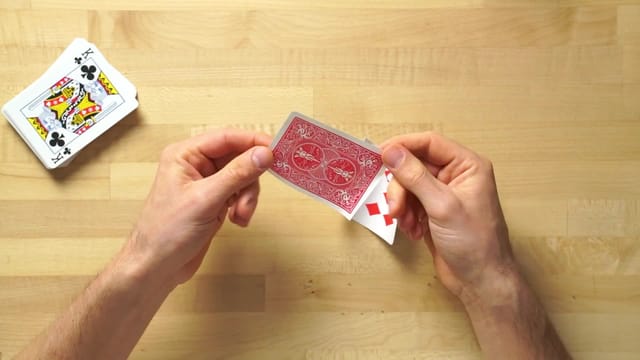
Card Splitting Fundamentals
The Old Way
Most magicians buy expensive, pre-made gaffed decks because they think creating their own is impossible or requires industrial equipment. You might have tried peeling a card before, only to have it tear, become transparent, or end up with uneven, clumpy layers that ruin the look of your trick.
The Better Approach
The secret isn't in fancy tools—it's in understanding the three-layer anatomy of a playing card. Once you know how to separate the face and back layers from the central opaque glue layer, you can create professional-grade double-backers and double-facers at home. By using the right technique to balance the thin layer with the thicker, glue-backed layer, you ensure your custom cards feel exactly like a standard deck. This lets you build your own gimmicks for a fraction of the cost of store-bought versions.
About the Instructor
Julio Ribera is a professional magician and content creator known for his practical, no-nonsense approach to magic. He specializes in breaking down complex technical skills into simple, repeatable actions that you can master at your own desk.
What's Included
- Understanding the three-layer anatomy of a playing card
- Identifying the thin layer vs. the glue-backed layer
- The proper way to "tap" the corners to initiate a clean split
- Step-by-step technique for consistent, smooth peeling
- Tips for combining layers to create custom double-facers and double-backers
- Advice on choosing the right practice decks to save money while you learn
Frequently Asked Questions
Why should I make my own cards instead of buying them?
Making your own cards is much cheaper, and it lets you create custom gimmicks for specific routines that you can't find in a shop.
Will this work with any deck of cards?
It works best with standard-quality playing cards. Julio recommends starting with an affordable deck so you can practice the technique without worrying about wasting money.
Is it hard to get the layers perfectly smooth?
It takes a little practice to get the feel for the tension, but once you learn how to start the split from the corner and peel diagonally, it becomes very consistent.