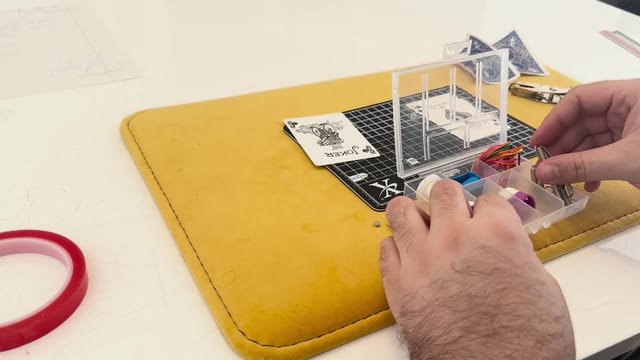
Card Splitting and construction of magnetic cards
Julio Montoro explains how to split the layers of a card and use that preparation to build two magnetic cards. The work focuses on embedding the magnets while maintaining a thin finish, rather than simply gluing them onto the surface.
Learning to split the layers
The explanation begins with peeling or card splitting. It shows how to open a corner and start the separation, including a tear that provides an opportunity to discuss how to try again from a different corner.
The content works on obtaining layers that can later be used as a cover. Practicing this separation is part of the construction process, not a result assumed to be mastered right from the start.
Perforation, orientation, and fitting
Montoro uses other cards as support and guides to punch the holes in matching positions. Emphasis is placed on keeping the orientation and not losing the alignment between the pieces.
The magnets must fit into the recesses of the construction. The explanation shows the use of tape to secure them and how the two cards relate when brought together.
Covering and finishing
Next, the trimming of the layers and their gluing to cover the assembly are demonstrated. Several adhesion options are discussed: double-sided tape, glue stick, or the specific adhesive used during the explanation.
The finish includes a suggestion for orientation marks and the possibility of adding another cover where necessary. The goal is to understand how to maintain the framing and reduce the visible outline of the magnets.
Materials and applications
You need cards to split layers and create the supports, magnets that fit the perforation, a hole punch, adhesives, scissors or a craft knife, and a cutting mat. The size of the magnets and the thickness of the assembly matter; it is not claimed that any magnet of any size will work.
At the end, possibilities are shown where the assembly appears to change between one and two cards. These are examples to understand the utility of the mechanism; the specific content is its construction, not a complete collection of routines.
The lesson teaches peeling and assembly with magnets, along with considerations for orientation and adhesion. It does not require purchasing the commercial effect that Montoro mentions when explaining the origin of the idea.