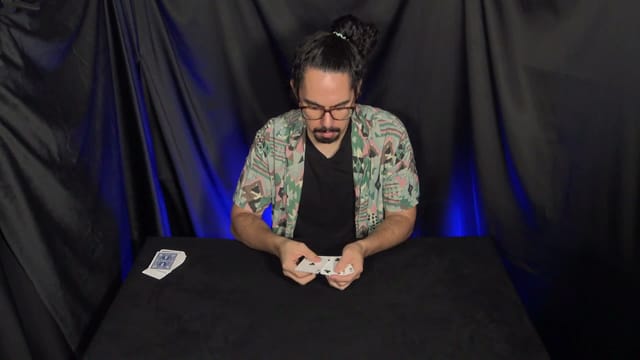
Acrobatic cards: reversals with a small packet
A spectator remembers a card, and Elías D’Sastre offers them a challenge: try to forget it while watching a small packet of cards. The ace, two, three and four seem to turn over at different moments, change orientation again and ultimately connect to that initial selection. The memory theme gives continuity to a long routine with several magical moments and a final phase reserved for the ace.
The lesson begins with the performance and then moves to the setup. You will learn to organise the necessary cards within the deck, preserve that setup during the handling and control the selection to the position required by the routine. Elías explains the swing cut, the cascade drop, breaks and the double cut, paying attention to the size of the break and finger positions. The queen of hearts is the card used in the example; the presentation allows the selection to be signed.
The initial production gathers the cards of the small packet and incorporates the selection into the handling. From there, the class works on displays, the Ascanio spread (culebreo) and the counts that allow you to present the ace, two, three and four naturally. The explanation shows how to keep together the cards that must be handled as one and how to link the actions without losing the arrangement needed for the next phase.
The first block of effects uses a succession of Elmsley counts and turnovers. A recognisable magical gesture alternates with an action in which nothing seems to happen, so that the audience can follow each change. The joint phase with the four and three is then developed, with face-up and face-down cards, a fan opening and further displays. The two features in a less predictable sequence before the finale with the ace is prepared and the routine returns to the card the spectator was supposed to forget.
The technical work includes doubles, multiple turnovers, breaks with different finger options, displacements, extractions and a sideways handling that Elías compares to a cull. He also spends time on delicate points: removing a card without exposing the one beneath it, squaring the packet without opening it, covering movements with the visible cards and maintaining the angles. These actions are studied within the routine and reviewed in a partial recap and a final complete run-through.
Presentation is part of the learning. Elías explains where to leave a pause, when to look up at the spectator and why it helps to repeat the same gesture for the same effect. Intervals of forgetfulness separate moves that would look suspicious if strung together too quickly. Conversation about the selection maintains a common thread through the different phases.
You need a deck of cards, the ace, two, three and four used in the setup, and a surface on which to place the packet. Add a marker if you want to present the signed-card version. No construction of a special accessory is described, nor is the purchase of a particular product required. The setup and handling sequence must be followed; rehearse the whole routine before showing it to an audience.
This lesson is for someone who already has some ease with breaks, doubles and packet counts. The Elmsley count and the Ascanio spread are explained in their application to the trick, with references for further study. The routine offers an opportunity to practise these techniques, drop-offs and rhythm, but requires repetition and care so that multiple cards behave as a single card.
The explanation cites Edward Marlo and Jon Racherbaumer among the routine’s references and attributes the production that Elías incorporates into the handling to Ricardo Vizcarra. It also refers to Ascanio and Gran Escuela de Cartomagia for further study of various techniques. Those works and external materials are study references; they are not presented as products included in the lesson.