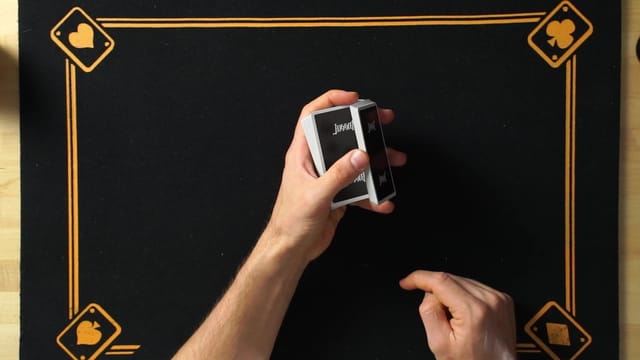
Charlier Cut: One-Handed Cut and Closing Control
The Charlier Cut allows you to cut the deck with just one hand. Julio Ribera explains the opening, passing one packet over the other, and the closing, paying close attention to the shifting support points throughout the action.
Two ways to start the move
The explanation begins in Straddle Grip supported by the palm and covers the opening of the upper packet. As an alternative for study, Julio demonstrates how to start in an elevated grip and let part of the cards drop to create the initial separation.
The lesson distinguishes between these two entries and their effect on the flow of the cut. The elevated alternative can help you recognize the position of the packets before linking the opening from the supported grip.
Elevating, shifting support, and closing
The next step involves using the index finger to elevate the packet and allow it to clear the other. Julio explains the shift in support that happens during this step and when the finger can be moved out of the way for the cut to close.
The reviews connect the work of the thumb, the index finger, and the other support points. The goal is to maintain control of the packets while the way you hold them changes.
The explanation also examines the closing as its own distinct moment: recognizing the supported packet, removing the index finger, and squaring up the cards. This is a section that can be practiced separately before aiming for a more continuous sequence.
Moving from segmented study to fluency
Julio demonstrates the cut broken down into beats and then describes a more fluid execution, where the push of the index finger helps keep the motion going. Both approaches are used to work on control before combining the actions.
To study the mechanics, he recommends trainers or practice blocks. He also suggests a homemade alternative using a deck divided into two packets bound with tape, so you can focus on the movements without having to keep all the cards in each packet aligned.
What you need
You need a deck of cards and familiarity with Straddle Grip. Practice blocks are a recommended aid; purchasing Cardistry Planks or any specific model is not required, and the explanation includes the option of preparing two packets for training.
The lesson is taught by Julio Ribera and breaks down the Charlier Cut step by step, covering alternative entries, support points, and the closing. The suggested practice focuses on controlling the movement and subsequently linking its timing together.