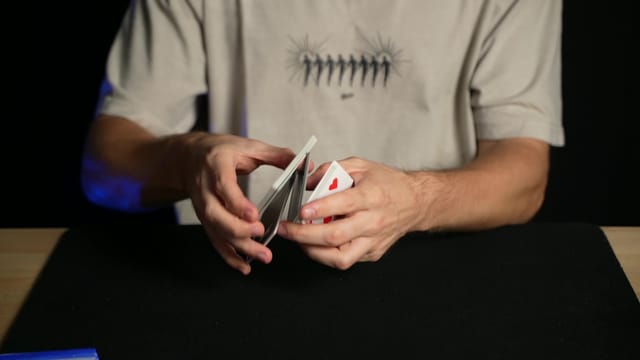
Chase Duncan's Bowtie: Three Movements for a Sequence of Revolutions
Bowtie, by Chase Duncan, brings together several packets that revolve at the same time. Julio Ribera organizes his explanation around three movements: a continuous rotation, a second revolution on the corners, and the incorporation of a new packet that combines with the previous ones. The lesson teaches how to recognize these parts, practice them separately, and bring them together into the complete flourish.
The Opening and the First Two Revolutions
The starting point is a double Z-cut, with small intermediate packets and a top packet from which new portions will later be extracted. The explanation uses a basic Sybil opening to set up the structure and pays attention to repositioning the thumb without losing control of the packets.
The first exercise isolates the packet that repeatedly revolves. Next, the second rotation is studied: its support on the corners, the pivot, and the change of contact between the fingers that allows completing the revolution and returning to a starting position. Julio reviews these actions from the front and combines the two revolutions before introducing the remaining element.
Adding the Third Movement
Once you recognize the first two rotations, the packet emerging from the top is incorporated. Here the work consists of coordinating its extraction and movement with the revolutions already underway. The explanation temporarily reduces the number of elements in play to clarify that relationship and then reassembles the set.
The reviews distinguish the moment a packet is separated, its transfer to the next support, and how to complete the revolution while the other actions continue. Julio separates the parts to explain them and points out that, during execution, one must strive for their coordination. That difference between studying the timing and executing the full movement is one of the pillars of the lesson.
Repetition and Flourish Exit
The tutorial shows how the sequence returns to a position from which it can continue. It also explains the decision that allows finishing: gathering the remaining packet and linking the final revolutions until the entire deck is gathered. It includes reviews of the movement and a section explained in slow motion, so that the study covers the entry, repetition, and closure.
What You Need and Who It Is For
You need a deck of cards and experience handling multiple packets. A double Z-cut and a basic Sybil opening are used; it helps to arrive with those basics down so you can focus on the pivots and their links. The specific movements of Bowtie are explained in parts, but the lesson is not a general introduction to cardistry.
Julio recommends trainers or practice blocks to keep the small packets squared up during learning. He explains with a deck of cards so their orientation is visible and does not require a specific commercial model. It is a lesson for anyone looking for a complex two-handed coordination flourish who wants to study both its components and the transitions from one to another. Chase Duncan is credited as the creator of the movement, and Julio Ribera is the one teaching it here.