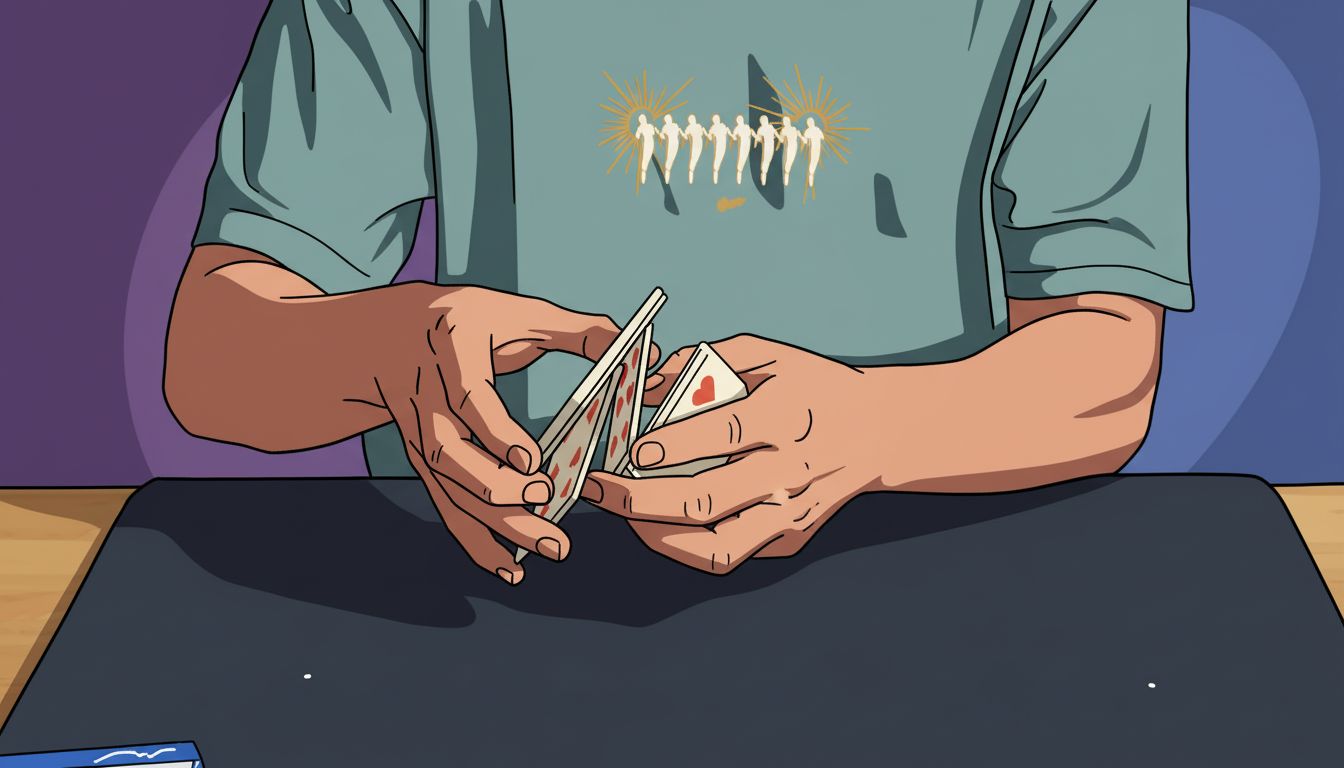
Cardistry Flourishes Masterclass: Squeeze a Square, Mockingbird, Bowtie and Nimbus

Four flourishes explained by Julio Ribera to work on geometric figures, packet spins, and two-handed coordination. From Squeeze a Square and Mockingbird to Chase Duncan's Bowtie and Nimbus, featuring openings, transitions, and closings.
Cardistry Flourishes Masterclass: Squeeze a Square, Mockingbird, Bowtie and Nimbus
Four flourishes explained by Julio Ribera to work on geometric figures, packet spins, and two-handed coordination. From Squeeze a Square and Mockingbird to Chase Duncan's Bowtie and Nimbus, featuring openings, transitions, and closings.
4 Lessons
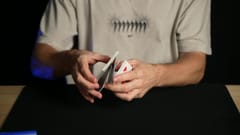

This path brings together four cardistry tutorials taught by Julio Ribera. Their common thread is packet coordination: building a recognizable figure, maintaining its pivots while it spins or moves, and linking the parts until the deck is squared up again. Each lesson develops a specific flourish, paying attention to the setup and closing, as well as the most visual moment.
Squeeze a Square: building and transforming a figure
The first lesson starts from Straddle Grip and a double Z-cut to form a square that compresses and shifts. From that structure, a scissor cut and a Revolution Cut are linked. Julio reviews the position changes and the coordination of the actions that must happen simultaneously, until squaring up the deck once more.
It is important to come prepared with the necessary fundamentals: the double Z-cut is treated as known and the Revolution Cut is explicitly mentioned as prior learning. The value of this lesson lies in integrating them into a geometric sequence.
Mockingbird: continuity between spins
The second explanation works on small packets that spin successively, an opening, and gathering the assembly. Julio clarifies his orientation with a deck and explains how the fingers, wrist, and the packets themselves help each other to complete the revolutions.
Here, the path of the hands takes on special importance. The lesson contrasts rigid direction changes with circular trajectories that allow the spins to be connected and continuity to be maintained until the closing.
Chase Duncan's Bowtie: combining three movements
Bowtie is organized into three components that are first studied separately. A double Z-cut opening and a basic Sybil are used to set up the packets; then two rotations and the incorporation of another packet are combined.
The explanation covers pivots, repositioning of pivots, and the timing of the sequence. It also shows how to return to the position from which it can continue and how to finish by gathering the remaining packet. The lesson includes a slow-motion segment and reviews of the whole.
Chase Duncan's Nimbus: a one-handed base, a two-handed flourish
The final lesson focuses on the one-handed cut that serves as the base for Nimbus: packet control, the space for the display, and the action that completes the revolutions. That cut is explained as part of the tutorial, before studying the path of the other hand.
Afterwards, the two parts, the extra revolution between the packets, and the closing are combined. The result uses both hands; the initial one-handed exercise is one of the pieces that builds it. Julio insists on practicing the positions and maintaining a fluid path, without needing to execute quickly.
Materials, knowledge, and scope
You need a deck and cardistry fundamentals to separate and hold packets with ease. The explanations employ previous grips and cuts; this path is aimed at developing multi-packet flourishes, not teaching all the fundamentals from scratch. Each lesson specifies which foundations are used and which new movements are broken down.
In Mockingbird, Bowtie, and Nimbus, Julio recommends trainers or practice blocks to study the spins without the cards getting misaligned. They are a recommended training aid, with no specific brand requirement; the explanations also resort to the deck to clarify orientations and movements.
The content brings together these four lessons in their current order. Julio Ribera is the instructor; Bowtie and Nimbus are attributed to Chase Duncan in the explanations themselves. The work covers openings, pivots, spins, transitions, and closings of the described flourishes, with reviews to connect their parts.