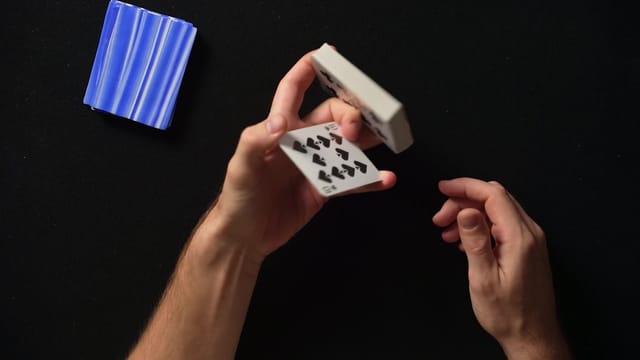
Chase Duncan's Nimbus: One-Handed Cut and Coordinated Twirls
Chase Duncan's Nimbus combines a one-handed cut with the twirls of a packet held by the other hand. The result relies on coordinating those two actions and linking them into a continuous path. Julio Ribera dedicates a large portion of the lesson to the foundation he considers most difficult, studying it separately and then explaining how to integrate it into the complete flourish.
First, the One-Handed Cut
The explanation begins in Straddle Grip. Julio works on the initial separation, the control of the small packet, and the space the middle finger needs to get involved in the extension. He doesn't just show the final position: he describes why letting a flat packet drop onto the hand makes it harder to continue, and what grip adjustments allow you to prepare the next action.
This part includes the rotation, extension, and exit of the cut. The instructor distinguishes between the help provided by the packet's weight and the action the thumb still needs to perform to finish the revolution. He suggests practicing the mechanics separately before adding coordination with the other hand.
Learning requires mastering unusual positions and repeating the sequence while paying attention to the grips. The lesson doesn't assume you already master this specific cut; it forms a central part of what is taught. It is, however, helpful to have experience with Straddle Grip and with separating and controlling packets.
Next, the Path of the Other Hand
The second part examines the right-hand packet: its orientation changes, its path around the other packet, and the wrist rotation that links them. Julio also explains the contact that helps complete an extra revolution before the close.
The main instruction is to avoid abrupt changes in direction. Instead of treating each forward and backward movement as an isolated action, you work on circular paths that connect the twirls. The goal of the study is to maintain that continuity; the explanation explicitly notes that there is no need to rush.
Combining Both Parts and Closing
The final stretch brings together the one-handed cut and the movement of the other hand. The tutorial reviews the moments when the packets meet, the extra revolution, and the final catch, closing one part first and then the other. A final review ties the positions back to the full movement.
The complete flourish uses both hands, even though its foundation includes a one-handed cut that is taught in detail. This distinction lets you know what you'll be practicing at each stage and prevents you from confusing the initial exercise with the entirety of Nimbus.
Materials and Preparation
You need a deck or cardistry practice material. Julio especially recommends trainers or practice blocks to study the mechanics without having to keep all the cards of each packet together; he also uses the deck to clarify parts of the movement. This recommendation does not require a specific brand or model.
This is a demanding lesson for anyone who already has cardistry basics and wants to work on a sequence requiring greater coordination. It includes the analysis of the initial cut, the grip and extension adjustments, the path of the other hand, and their combination up to the close. Chase Duncan is the creator mentioned in the explanation, and Julio Ribera is the instructor of this tutorial.