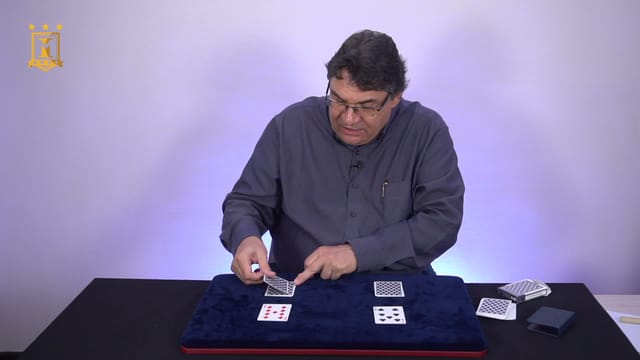
Spatial Clarity: Follow the Leader and Cups and Balls Opening
Roberto Giobbi explores the relationship between the spot where something is shown and the information the audience receives. His concept of the "space-information continuum" is applied to body language, a Cups and Balls opening, and a short version of "Follow the Leader". The session combines performance theory, acting, and the breakdown of the sleights.
Giving Information a Place
- The lecture kicks off with a communication example: assigning a spot to each person or idea being discussed and returning to that spot when revisiting it. Giobbi proposes this as a way to structure your delivery and make it easy to follow, whether you're seated at a close-up table or standing before a larger audience.
In magic, this rule dictates where an object is shown, where a condition is confirmed, and where the effect is expected to happen. Hand placement and the direction of the displays are studied as core parts of the communication, right alongside your patter.
Cups and Balls Opening
An opening with three cups, a magic wand, and the production of three balls is presented and broken down. The analysis contrasts the initial image of the empty cups with the way the displays are repeated in the same space. The handling is also fine-tuned so the setup allows you to present the props with absolute clarity.
This sequence leaves an extra ball in play to roll right into a routine. The focus here is strictly on the opening: Giobbi mentions Dai Vernon's routine as a personal follow-up, but doesn't teach the full routine.
Follow the Leader with Red and Black Cards
This version uses five red cards and five black cards. One card represents the leader of each family, and the rest make up their group. As the leaders switch places, the groups appear to follow them. The presentation then plays with shifting the families around and a final kicker that seems to call for a more forceful gesture.
The explanation breaks down the selection of the cards, the prep during the displays, and the control beneath the spread. You'll study how to naturally transition into the required grip for the next move, utilizing the morphological movements Giobbi connects to Gabi Pareras.
The colors need to be easily distinguishable: using high-value spot cards is recommended, avoiding face cards since their color mixes can kill the contrast. The exact value of each card doesn't affect the trick.
Displays, Continuity, and Repetition
- The analysis of the routine focuses on keeping two locations and two families distinct without overwhelming the spectator. The leader cards act as anchors. The video reviews where to turn over each card, how to repeat a gesture consistently, and how to use crossed hands to visually cue an exchange.
The handling features a double lift to confirm a phase, smoothly flowing into moments that take full advantage of the established setup. The explanation draws a line between the technical structure of the effect and how clearly the audience can follow along.
Repetition is treated as a presentation challenge: once you've established the effect, it's best to throw in a variation. Here, the family changes instead of the leader, building a little tension right before the final reveal, played with a subtle reaction.
Props and Practice
For the card routine, you'll need a standard deck to pull out five red and five black cards, plus a table to separate the groups. You should be comfortable with spreads, the spread cull (control beneath the spread), and the double lift; the real challenge lies in coordinating your positions, displays, and timing.
To practice the Cups and Balls opening, you'll need three cups, a magic wand, and four balls: three appear during the sequence, and an extra one is set aside to keep going. These are specific to that routine and have nothing to do with the card trick.
The final takeaway is to run through one of your own routines from start to finish and spot where a cleaner placement could level up your communication. Giobbi suggests running this analysis on several routines to bake this concept into your everyday practice.