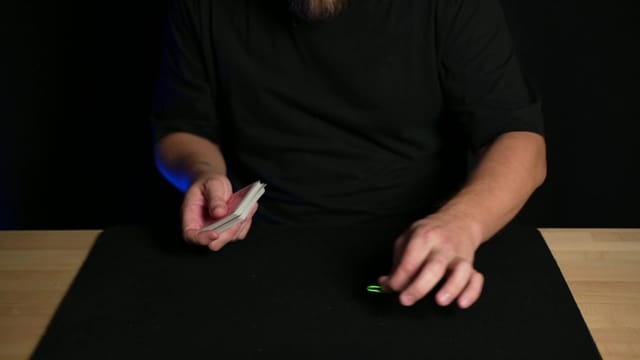
Clip Card Location: Handling and Revelation
A paperclip becomes responsible for finding the chosen card. After losing it and shuffling, you spread the deck on the table and the card appears clipped. Yago Turia's lesson includes a demonstration and an explanation of how to set up the materials, handle the selection, and build the revelation.
Preparing the materials and receiving the card
The routine uses a deck of cards and two standard paperclips. Yago explains how he places one of them on the deck, which orientation works best for him, and how he leverages the grip of his hand and the cards to keep it covered during the selection.
He then moves on to the shuffle and receiving the spectator's card. The explanation focuses on the tactile feedback of pressure that lets you recognize the working point and the coordination needed to insert the card and square the packet again. The casual appearance of the action and the care required to maintain that appearance are closely studied.
Building the revelation on the table
The next section focuses on placing the visible clip and executing the spread. Yago explains how he relates the position of the props to the path of the cards so the appearance happens in the intended spot. He also clarifies the grip he uses when switching the deck from hand to hand and the necessary cover during that transition.
The revelation requires paying attention to the cards that end up clipped: the tutorial explains how to display the result and how to handle it as a double card when appropriate. The study of the effect therefore covers the setup, the coordination of the spread, and the manner of showing the discovery.
Choosing how to finish
The lesson discusses various outs after showing the card: lingering on the image of the appearance or gathering the props using different handlings. Yago outlines options for managing the clip left in the deck while squaring and points out the careful handling required during this collection.
This allows you to study a clean finish suited to your working position, without assuming that every collection leaves everything set up the exact same way. The explanation includes possibilities that utilize the table, the hand, or lapping depending on the chosen handling.
Materials and preparation for practice
You will need a poker deck, two paperclips, and a table where you can spread the cards. The paperclips are ordinary ones; no specific magic gimmick is required. The preparation of the materials is part of the explanation.
The work focuses on the grip, touch, control of the spread, and managing the ending. It is best to practice these moments separately before linking them together with the selection and the presentation. Yago is left-handed and mentions this during the explanation; keep that orientation in mind when adapting the handling to your own hands.