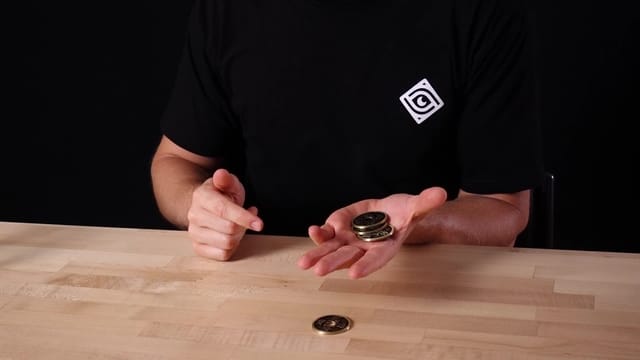
Coin Through Table Mechanics
The Old Way
Most people try to perform coin penetrations by focusing entirely on the sleight. They stare at their hands, move jerkily, or try to hide the coin with awkward, cramped fingers. This creates tension that tells the spectator exactly where the "trick" is happening.
The Better Approach
This method relies on fluid motion and natural psychology rather than hiding your hands. You use the edge of the table to do the dirty work—lapping—while keeping your hands in a relaxed, open position. By using specific misdirection techniques, like shifting your gaze to the receiving glass, you lead the spectator's attention away from the secret movement. When you make the movement look like a simple, incidental action, the "magic" happens in their head, not just in your hands.
About the Instructor
Julio Ribera is a Spanish magician known for his practical, no-nonsense approach to close-up magic. He focuses on "universalizing wonder," meaning he strips away the ego and fluff to teach you the specific moves that actually get reactions from real people.
What's Included
- How to hold coins naturally using the classic palm
- Techniques for lapping a coin during a fluid hand rotation
- Using the glass as a focal point to cover secret movements
- Managing spectator attention to eliminate doubt
- The timing of the "drop" to ensure a clean, silent penetration
Frequently Asked Questions
Why is this method better?
It doesn't rely on being "fast." It relies on controlling the spectator's focus. Because your movements are justified by the props—the glass and the coins—the audience never suspects a move is taking place.
Will this work for me if I'm not a pro?
Yes. You don't need years of practice to master the palm. You need to understand the rhythm. This lesson breaks the sequence down into two simple beats that you can practice anywhere with a table.
Do I need a special table or coins?
No. This works with any table that allows for a natural lap and any standard coins you have on hand. It's designed to be performed anytime you have a surface to work on.