Card Coincidences and Date Revelation
From Small Coincidences to a Date
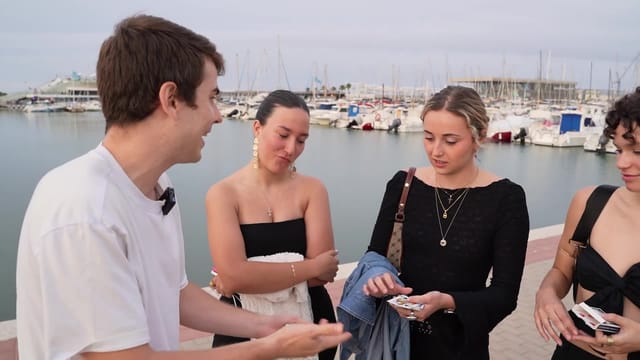
The magician and the spectator work with individual packets of cards, shuffle, cut, and exchange cards. Some coincidences seem small or incomplete until the finale gives them new meaning: the cards reveal a date meaningful to the presentation.
Julio Ribera performs the effect for an audience and then explains how to construct it. The lesson presents both the date routine and the tool that lets you decide which coincidences will take place.
Presentation and Construction of the Finale
The performance lets you see the dialogue about chance and destiny, spectator participation, and the way significance is gradually built into the coincidences. A trial that seems merely illustrative takes on new meaning upon reaching the final revelation.
In the explanation, Julio discusses why he alternates clearer coincidences with partial ones to build rhythm. He also uses pairs of aces, queens, and tens so the mechanics are easy to follow. The dates in the examples belong to their respective demonstrations: the approach adapts to whatever data you wish to present.
Preparation, Shuffles, and Participation
The tutorial explains a small setup with the cards that must be involved in the coincidences. It then shows how to preserve it using a false shuffle or a control while the presentation maintains the illusion of chance.
Julio applies his overhand shuffle handling, pinky breaks, and cuts to the effect. He mentions other possibilities and refers to his specific explanations to expand on controls; here you can study the handling he uses in this routine.
Dividing into packets, spectator shuffles, cuts, and exchanges are all part of the sequence. The explanation details which actions must be coordinated to repeat the coincidences and move on to the next phase.
Two Ways to Resolve the Exchange
The main version uses a double lift, along with the subsequent handling that allows you to finish each coincidence in a position to continue. Julio offers an exposed view, repeats the action, and explains how to get the break ready during the exchange.
He also teaches an alternative where the cards are moved to the bottom of the packet. This option simplifies the handling for anyone who hasn't yet mastered the double lift, although it still requires controlling the break and the cards as shown in the tutorial.
Adaptations and Materials
You will need a regular deck and to prepare the appropriate cards for whichever finale you choose. Practice focuses on the shuffles or controls that preserve the setup and on the exchange version you plan to use.
Julio suggests birthdays, phone numbers, and connections to other effects as presentation ideas. These are possibilities for adapting the tool explained; the development of each does not constitute an additional routine taught separately. The core of the lesson is progressive coincidence and its application to revealing a date.