

Card Coincidences and Predictions


Two card magic routines presented with a mentalism style: Julio Ribera turns a series of coincidences into a date, and Pablo Costas reveals a prediction among cards held by the spectator. Includes performances, explained handling, and alternatives using standard decks.
Card Coincidences and Predictions
Two card magic routines presented with a mentalism style: Julio Ribera turns a series of coincidences into a date, and Pablo Costas reveals a prediction among cards held by the spectator. Includes performances, explained handling, and alternatives using standard decks.

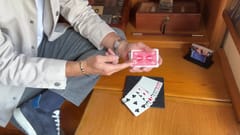
Two ways to present an impossible coincidence
This learning path brings together two card routines where the patter leads to a revelation: a date that appears after several exchanges and a prediction that seems to have remained among the spectator's cards.
Julio Ribera teaches the first proposal and Pablo Costas the second. Both lessons include performance and explanation, working with a standard deck.
Card coincidences and date revelation
The path begins with Julio's routine. The magician and the spectator shuffle and cut their respective packets, exchange cards, and look for coincidences. The patter about chance and destiny sets up the revelation of the date.
The explanation covers the set-up, shuffles, and controls that retain the necessary cards, as well as how to coordinate the exchanges. It includes the handling with a double lift and a simpler alternative that moves the cards to the bottom of the packet.
The interest lies as much in the mechanism as in the construction of the coincidences: some serve as examples, others create a small magical moment, and the finale gives meaning to the whole. The dates in the demonstrations are adaptable examples. Birthdays, phone numbers, and connections to other effects are proposed as ideas to develop, without being presented as full additional tutorials.
Fan prediction with a normal deck
The second lesson is by Pablo. A prediction is kept among other cards held by the spectator and ends up matching the chosen card during the card spread.
The video contains a live performance, explanations of the partial fan, the bottom-card buckle, and the Biddle steal, a detail to recover the packet with more continuity, and a complete recap. The prediction remains hidden inside the packet: it is not presented as a card whose identity stays visible throughout the entire effect.
Material, practice, and scope
For both routines, you can work with a standard deck. Julio's routine requires a small set-up for the chosen outcome; his handling requires practicing the controls and one of the two exchange versions. Pablo's explains the three components he links, showing a deck preference and a close-up pad for his table-hopping work.
The path allows you to study two constructions, two ways of interacting with the spectator, and different card magic sleights in the service of a coincidence or a prediction. The mentioned materials and necessary techniques are detailed in each lesson.