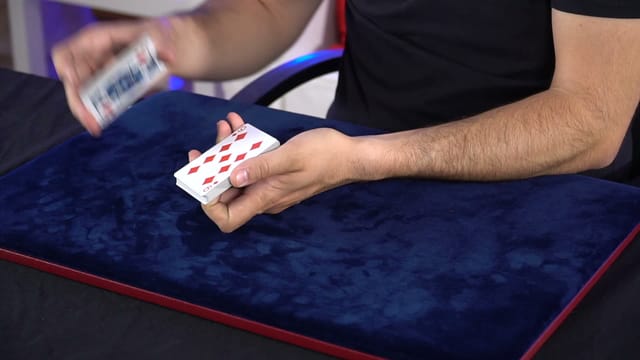
Card Controls: Diagonal Insertion, Fan, and Glimpse
Bringing a Card to the Position You Need
A control lets you place a chosen or thought-of card into a known spot in the deck to keep the routine moving. Borja Montón covers several methods to achieve this from different scenarios: a card returned to the middle, a selection via a glimpse, a fan, or an in-the-hands shuffle.
The explanation bridges mechanics with audience perception. You'll study when to finish an action, when to drop a beat, and how to prevent the return of the card from looking too closely tied to the control move itself.
Double Cut and Controlling an Apparent Mistake
The double cut serves as the foundation for several applications. The grip, maintaining a break, and the flow of the packets are thoroughly explained. Borja compares squaring the deck completely with a more continuous execution, noting the differences between the handling he recommends for beginners and certain habits he relies on when performing.
The Oops! Control capitalizes on an apparent error during the presentation. He explains its setup, the selection and return of the card, and the attitude needed to handle that minor hiccup smoothly. The key is making the action look casual and giving it just the right amount of weight in your patter.
Diagonal Insertion and Fan Variations
The diagonal insertion section covers hand positions, finger pressure, and hand coordination. The moves are shown exaggerated to clearly map out the path, then contrasted with the minimal amplitude a real-life handling requires.
We look at side and in-jogged placements, how to hold a reference, and options for finishing with the selection at the top or bottom. He also teaches a variation that shortens the travel time and another presentation where the cards look like they're losing their order while still keeping the control possible.
The work isn't just about moving the card: the hand position and the bevel of the deck help cover the action. Borja ties these covers into a conversational pause and a time-lapse of forgetting, separating moments that the spectator might otherwise link as cause and effect.
Diagonal insertion from a fan lets the participant return their selection into a different setup. He discusses fan pressure, squaring it up, and the flow right into the control.
The lesson also adds the LePaul fan control. He demonstrates how to adjust the pressure without bending the card, square up the deck, and keep the necessary reference to guide the selection to your target spot. Card orientation and audience visibility are key parts of this analysis.
Glimpsing One or Two Cards
A glimpse lets someone spot a card by stopping a run of cards without pulling it out of the deck. We cover the grip, the bevel, and the timing for holding a break.
The explanation scales up to two choices, showing how to juggle two references to end up with one selection at the top and another at the bottom. We review transitions and the natural motion that masks the first choice so the action doesn't stand out.
He also shares an option where the spectator traces their finger along the cards and calls stop. Borja talks about how to hold the deck to allow for that interaction and then finish the control. These variations tie into a vertical performance position, keeping the cards facing those who need to see them.
Controlling While Shuffling or Cutting
The in-the-hands shuffle is used to receive a selection and hold a reference while dealing out packets. He covers pinky handling, recovering the break, and a correction if you lose your first reference while squaring up a card.
From there, he suggests drills to track the selection and shuttle it between the top and bottom. He teaches a shuffle that preserves the bottom card and circles back to the double cut as an alternative for shifting its position.
The goal of this practice is to keep the shuffle looking completely ordinary. The tutorial encourages building confidence without locking up the whole deck in an unnecessary death grip, ensuring you always know where your card is before calling the next shot.
Application: Two Cards and the Question Mark
Starting with the effect itself, explained at the end: two cards spotted by the participants are controlled and revealed within a patter theme about magic as a mystery. The glimpse and cuts blend into a table shuffle that locks the selections at the ends.
A quick look at a question-mark spread builds the final table picture. The main focus stays on the choice, the control, and the presentation of the two cards; the flourish is just the visual punctuation mark for the routine.
Materials and Requirements
You'll need a standard deck. A table or close-up pad with enough room to spread cards lets you follow along with the final application and practice the cuts and reveals.
You should know how to hold the deck in dealing and cutting grips, hold a small break, and execute a swing cut. The latter gets used, though the instructor notes he won't be teaching it in this recording. The double cut and main controls are covered thoroughly. Practice each move on its own first, then layer in your patter, pauses, and audience directions.