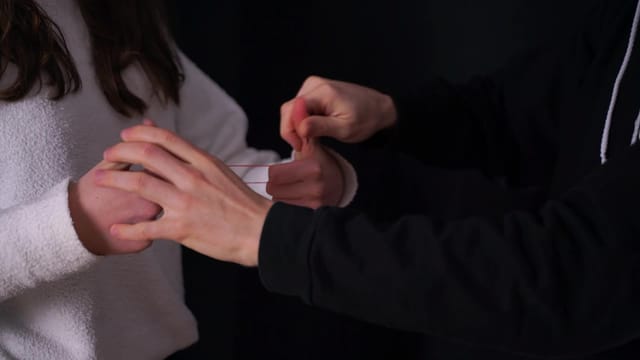
Crazy Man's Handcuffs
Crazy Man's Handcuffs creates the impression that two rubber bands penetrate through each other despite being trapped between the fingers. Julio Ribera performs the effect and explains both the version in his own hands and the adaptation where the spectator holds one rubber band.
The two videos feature a performance and the explanation of the handling. The required props are two ordinary rubber bands that can be handed out for examination.
Making the situation clear
The presentation begins by showing where the rubber bands appear to be trapped: the fingers define a path and the other rubber band blocks the way. That initial clarity ensures the subsequent separation makes sense.
Julio explains the placement and the pinch that keeps one rubber band secured as it is introduced between the fingers of the other hand. The handling unfolds from that position, with important movements being repeated.
Coordinating both hands
A core part is maintaining a similar hand shape in both hands. Julio shows why a very open hand and a very closed hand can draw unwanted attention, and how he matches his movements.
The explanation covers the stretching, the tilting of the fingers, and the timing of returning to the starting position. The sleight is connected to the broader action of showing that the rubber bands remain trapped.
The goal is for the separation to be perceived as the chosen magical moment, within a coherent sequence of movements.
Maintaining visual continuity
Julio explains how he uses a brief movement of the rubber bands before separating them. He also points out that this situation shouldn't be prolonged for too long.
The rhythm between checking the apparent boundaries, returning to the position, and showing the penetration is studied. These are construction details that accompany the learning of the technique.
The phase with the spectator
The second phase uses the same principle, but one rubber band is held between the participant's fingers. It explains how to ask them to position their hands and thumbs, and how to keep them away from their face.
That setup provides the space to introduce the other rubber band and repeat the appearance of them penetrating each other. The explanation includes the instructions and the adaptation of the movements to the new context.
You need two ordinary rubber bands and a participant if you want to perform the second phase.