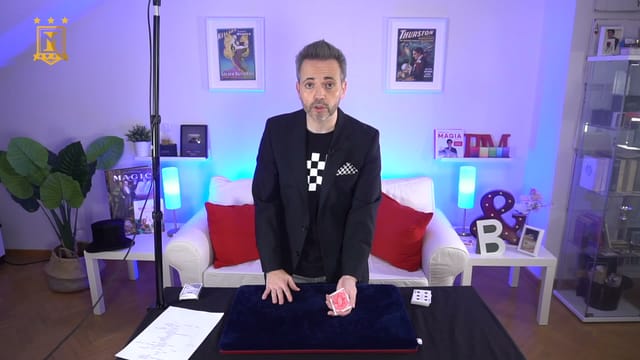
Counts and Displays: Jordan, Biddle, Hamman, and Olram
A false count must preserve the clarity and cadence of a genuine count. Miguel Ajo goes over several counts and displays for small packets, focusing on which hand holds, which counts, and what the spectator actually sees. The masterclass blends concealment techniques with nuances to ensure the cards are shown with ease and clear intent.
Elmsley Reference and Jordan Count
Starting with a review of the Elmsley count, the focus is on dividing the workload between the hands, the peeling action of each card, and maintaining a steady rhythm. The real move is compared to the false one, analyzing why both hands shouldn't move without a recognizable hierarchy.
Next up is the Jordan count as a companion to the Elmsley. Its mechanics are broken down, adapting the push-off and practicing both counts alternately. This comparison helps study which card gets hidden and how to prevent the habits of one count from messing up the other.
Biddle and Hamman
The Biddle count is tackled as a utility move to add, discard, interleave, and recount cards. You will learn how to get and keep breaks during the count and how to mix and match these options depending on what your routine requires.
Using an example with red and black cards shows how handy it is to sort them during your patter. This is an application of the handling, not a full oil-and-water routine taught from start to finish.
The Hamman count is taught using a nine-card packet. The explanation covers packet grip, finger placement, and keeping the change smooth throughout the count. A uniform-tempo execution is compared against the dips attributed to Ascanio: rhythm changes woven directly into the count rather than just popping up when the hard part hits.
Olram and Displays of Identical Cards
We study the Olram count to conceal a face or back within a four-card packet. Gaze and the appearance of each card guide where the spectator's attention goes. We discuss how the similarity of the cards used affects the move and how to individualize what is shown.
To display a packet of seemingly identical cards, we cover the Frustration Count, a Hamman display, and the Rumba Count. We compare their gestures, turnovers, and required grips. The Rumba Count is also shown as a way to display seemingly matching backs.
This lesson draws a line between demonstrating a condition and corroborating something the spectator already accepts within the effect. We work on that intent so the display supports the presentation rather than turning into a mechanical repeat of the exact same image.
Ascanio Spread and Honest Display
We review the Ascanio spread as both a spread and a concealment tool. The details focus on giving it a clear purpose, such as showing or laying down cards, rather than always rubbing or shifting the double card without a presentational reason. This is a review of subtleties, not a ground-up tutorial of every single variation.
The honest display is explained by focusing on the path of the last card and the feeling of freedom when opening your palms. Miguel shares a tweaked straddle grip to keep everything aligned and allow for the final slide. We walk through the sequence step by step, touching on symmetry and overall naturalness.
Materials and Practice
Grab a standard deck to set up small packets, including four-card groups and the nine-card Hamman example. Contrasting faces or colors make it easy to check what's visible during your practice sessions. Odd backs are just an example condition for certain concealments, not a mandatory prop for the whole masterclass.
You should already know the Elmsley count, blocking a push-off, and getting a break, as these are used as reference points throughout various handlings. Practice the real count alongside the false one, check the clarity of each display, and work on your rhythm without telegraphing the sleight with your fingers.