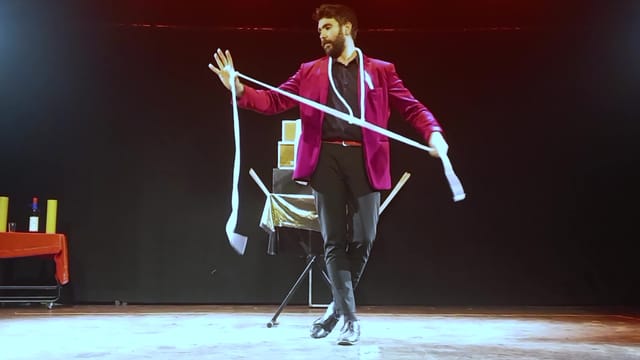
Cut and Restored Rope: Building a Musical Routine
A rope is cut, restored, and goes through various configurations of knots and lengths before being shown whole once again. Borja Mazorriaga explains a musical routine built from several rope magic handlings and shares the decisions that make it possible to link them together.
Preparing Materials and Study
You will need a long rope and scissors. Borja uses a length of about five meters as a reference and explains how to adapt it to the performer's height and handling. The rope is actually cut during the performance and shortens with repetitions; he recommends understanding the sequence before starting to rehearse with the physical props.
The routine is divided into three main parts, which can also be studied as independent segments. References to Professor’s Nightmare and Fiber Optics describe the integrated handlings; you are not required to purchase any specific product by those names to follow along with this explanation.
Cuts, Restorations, and Knots
The tutorial begins with a cut and restoration using a jumping knot. It continues with a phase combining a sliding knot and a jumping knot, reversing the order of tying and cutting. Body supports, identifying the ends, and the differences between the knots involved are all covered.
The final part develops a three-rope configuration, the count to display them, and a sequence of joins, loops, and restorations. The explanation repeats the steps from different angles and discusses coordination errors that could expose the handling.
Shaping the Finale
Borja works on how to display the rope, manage the pieces and knots that are handed out, and use the applause to continue or pack up. The finale includes presenting the rope and clearing away the props. Precautions regarding the scissors are addressed as part of their use.
Adapting the Music to the Routine
The lesson explains the process of testing various musical pieces over an already established routine structure. Musical beats and shifts in intensity are tied to moments of displaying the prop, looking at the audience, and executing a magical effect. It is also suggested to leave room to acknowledge the applause.
It is best to study rope sleights and handlings at a calm pace: this explanation applies and reviews many techniques, but points you toward basic rope magic study for deeper practice. The main focus is to understand the complete composition and rehearse it phase by phase before bringing technique, performance, and music together.