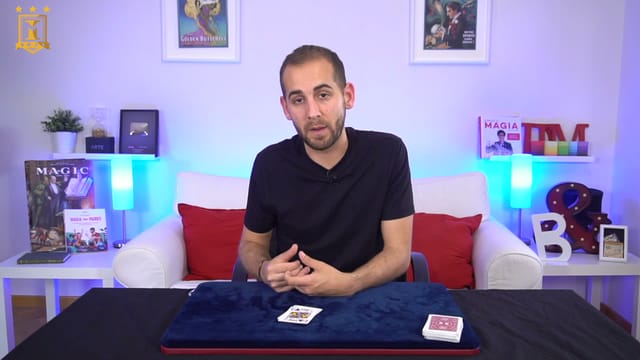
Table Lapping: Cover and Card Transformations
Víctor Piña breaks down card lapping and how to weave it into a table magic sequence. This session pairs lapping mechanics with misdirection, culminating in a killer routine where a packet of kings vanishes and turns into two signed selections.
Finding the Right Moment to Lap
Lapping is taught as a secret sleight: its cover relies entirely on where the audience's attention is focused at that exact fraction of a second and the logical motivation of your actions. Ascanio's distinction between false moves and secret sleights helps you discern which parts of your handling demand visible precision and which require a well-timed opportunity.
Hand-to-hand contact serves as the launchpad for working out potential laps. We look at card examples and break down which movements lead into that contact naturally. Grabbing the engine of the technique lets you tweak the gestures to fit any routine.
Mechanics and Hand Positions
This breakdown covers the motion and braking required to drop the cards neatly into your lap. We look at table edge proximity, hand-to-hand contact, and front-on cover.
Your positioning needs to let you pull off the move as part of a casual action. Telegraphing the prep right before you lap is a dead giveaway that something fishy is going down. That is why we cover pre-sleights: getting into position early using natural gestures that already serve a purpose in your patter.
Tension, Relaxation, and Flow
Slydini's principles are applied to posture, footwork, and body movement. Víctor demonstrates how a simple torso twist builds tension and how releasing it shifts audience focus. The arms move in sync with the body so that shifting one hand becomes part of a broader gesture.
We analyze this coordination using a full deck vanish demonstration. We cover moving away from the edge, arm distance when showing the effect, and the flow between prep, the lap itself, and the final flourish. The goal is to drill the whole sequence with a smooth, consistent rhythm.
From Four Kings to Two Selections
This routine uses two chosen cards and a four-card packet, represented by the kings. First, there's a visual orientation change; then, the packet shrinks down to just two cards, which turn out to be the selections.
We cover getting the selections back into the packet and a variation of the Elmsley count. We check out where the hands cross during the count and how to sneak the lap in right there, timing the push, retreat, and stop.
We gradually widen the count to move the hands away from the working area. A beat of silence builds up to the big reveal. The analysis shows how the count itself and the first phase give you rock-solid motivations for your moves and set up the final transposition.
Requisites and Prerequisites
You will need a standard deck, a table, and a chair to practice seated with lap access. It helps to know the Elmsley count, how to control two cards to the top, hold a pinky break, and add cards to a packet. The pass is explored as a control option, along with the double undercut.
Practice releasing the cards and squaring them to the table edge first. Then layer in the prep, body shifts, and the exit from the lap. Tailoring this to your own posture and working style is part of the grind, right along with getting your finger work down cold.