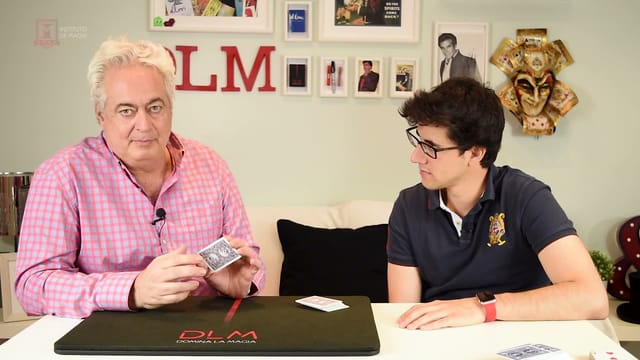
Double Lift: Preparation, Turnovers, Handling, and Applications
A Comprehensive Study of the Double Lift
Rafael Benatar breaks down the double lift into its stages, connecting the technique with fluency, attention, and presentation. The lecture offers an overview of methods so you can choose those that suit your hands and context. It combines demonstrations, detailed explanations, exercises, and complete routines that allow you to work the resources within a sequence.
A distinction is made between lifting and turning over, studying preparation, obtaining a break in the deck, handling in the air, recovery, and various ways to continue the action. Attitude and body coordination are worked on alongside finger mechanics.
Preparation and Obtaining Breaks
Procedures with prior preparation are compared to those that integrate it into the action itself. The analysis helps decide when it is best to anticipate an action and how to associate it with a question, a gesture, or a routine situation.
The overview includes methods during spreading and squaring, beveling and crimp resources, the pinky count, and a thumb alternative. The size of the breaks, the tensions they produce, and how to maintain them discreetly are explained.
Among the procedures integrated into the turnover, the Hit Double Lift, the Knockout, Ken Krenzel's natural double lift , and a Hamman handling are studied. Touch and control exercises are proposed to recognize what is being handled, and emphasis is placed on selecting practical solutions for each individual.
Turnovers and Handling
The explanation compares the hinge turnover, the forward turnover, Benatar's slip double turnover , and the Stuart Gordonhandling. Grips, contact points, pressure, hand travel, and the sensation of lightness are practiced.
A three-minus-one handling and its application in a routine are also studied. Exhibitions, small gestures, and some functional flourishes serve to explore how to give continuity to the movement and gain confidence. It is suggested to manipulate the cards calmly during practice, testing possibilities and observing when alignment is lost.
Maintaining the break gets its own dedicated section: finger retention, pinching at the base of the thumb, and options with projecting cards. These resources are related to the turnover used and the subsequent action, allowing movements to flow comfortably together.
Loads and Replacements
Projections, push-offs, and top loads are compared, focusing on their function within the routine. The analysis includes what draws attention, what needs cover, and how to make the path respond to a comprehensible action.
Table work includes the slip placement, the pendulum placement , and the principle Benatar calls the nail and the edge. It studies how to evaluate a placement, adapt one's gesture, and what conditions allow the hand to withdraw smoothly.
The condition of the deck, its finish, the working surface, and humidity are discussed. Practice helps verify which handlings are reliable with the available material. Placements are placed within concrete actions of a routine, paying attention to exposure time and viewing angles.
Naturalness, Language, and Attention
The psychology section reviews what to say when showing a card and how to continue the conversation while the action changes. It studies the difference between naming what is shown and adding statements that invite the spectator to verify a situation.
Placement to the left or right is analyzed based on hand travel and audience position. Gestures, questions, movements, and moments of pause are compared so that every action makes sense within the presentation.
The practical goal is to unite technique with a comfortable attitude: looking at and listening to the participant, maintaining a clear rhythm, and preventing a setup from interrupting the flow of the trick. Solutions are evaluated by their usefulness in a specific situation.
Routines to Apply the Techniques
The Challenge, by Dai Vernon. A choice between two cards allows you to work on two consecutive doubles and handling continuity. The opening trick, its setup options, and the rhythm needed to present it directly are explained. Its use as an auxiliary trick within a session is also discussed.
The Karate Trick. A card seems to turn into two lower-value cards after a strike. Two phases with different methods, card preparation, and alternatives for presenting the strike are explained. The sequence serves to study the combination of handlings and how one phase modifies the expectations of the next.
A Marlo Variant. A card shown as incorrect ends up revealed as the chosen one. An application of the slip placement is performed and explained, paying attention to the spread, angles, and the moment the participant and the rest of the audience discover the change.
Heat Transposition. Two cards swap places, adding a phase of invisibility and recovery. The routine brings together preparation, handling, loads, pendulum placement, false naming, and the Rub-a-Dub Vanish. The complete sequence is explained and reviewed to study how the resources fit together.
The closing performance with kings and countdown is kept as a sample of the instructor's repertoire; its explanation is not included.
Material and Practice
You need a standard deck of cards and a table; a close-up pad is especially useful for the placements and explained routines. Some applications require arranging a few cards before starting. For the chosen card variant, it is helpful to know a control to bring it to the necessary position.
The introduction starts from the fundamentals, but finer handlings and complete sequences require fluency with the deck. First, choose a preparation and turnover you can perform with confidence, link them with the continuation of the movement, and then try the applications. Various options are offered to develop your own handling and continue practicing with concrete criteria.