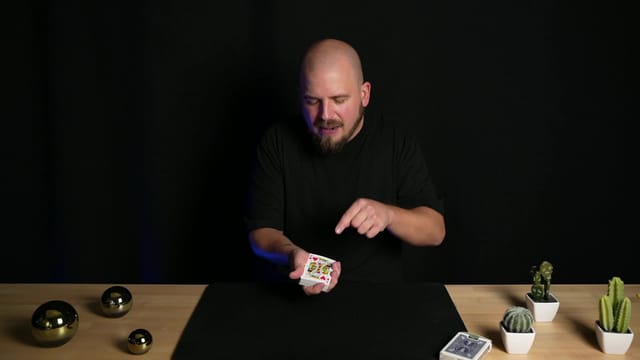
Double escape sandwich with cards and a rubber band
Two court cards act as accomplices to find a card inside a deck secured by a rubber band. In the first phase, they pop out along with the selection; then, a second sequence brings the chosen card back between the two court cards and triggers another release of the packet. Yago Turia demonstrates both phases and explains how to set up the props and link the revelations.
Setting up the trick during the handling
The tutorial uses a deck of cards, a rubber band, and a pair of accomplice cards. Yago chooses the two red kings, though he mentions you can use any other pair. The rubber band must be firm enough to keep the deck securely bound.
The explanation covers the selection and control of the card, the double cut, and getting the necessary break. Different ways to set up that break are discussed so you can choose a handling that fits your skill level.
First phase: setup and toss
Yago explains the placement of the rubber band and the face cards, the turns needed to get the packet ready, and the grip before making the release happen. The first toss is performed close to the table and is studied along with how to pick up and show the result.
The display is also part of the learning process. The tutorial explains how to handle the small packet to present the sandwich image and then show the chosen card. It doesn't stop at the visual release: it develops the revelation that gives it meaning.
Linking into a second phase
The second part builds on the previous handling to set up the continuation. Yago explains how he repositions the cards, resets the rubber band, and what changes in the grip to produce a different release.
On this occasion, pressure control allows for a slow-motion escape with a finger glide before showing the card between the two kings. The lesson distinguishes this release from the first one, rather than simply repeating the exact same toss.
The whole routine allows you to work on a two-impact sequence with the same props, paying attention both to the setup of each moment and to the transitions that keep the presentation flowing.
What you need and what is practiced
You need an ordinary deck of cards and a rubber band that fits it snugly. The accomplice cards come right out of the deck; no special novelty pair or extra duplicate is required for this handling.
Controls, breaks, and displays of multiple cards as a block are used. Yago explains the actions involved in the sequence and alternatives for getting into certain positions. It is best to practice placing the rubber band, the grip, and showing the packet separately before putting the two phases together.
The lesson contains a demonstration and explanation taught by Yago Turia. The instructor is left-handed, so keep that orientation in mind when following along with his actions.