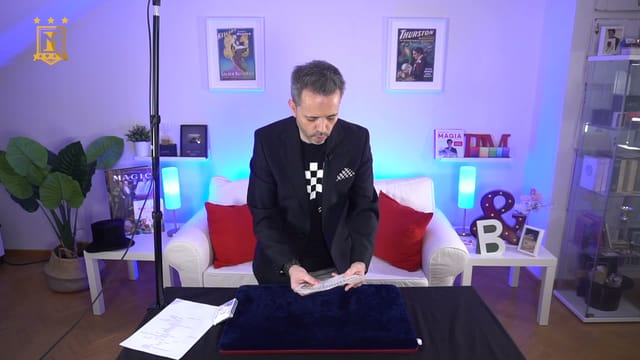
Card Push-Offs and Additions: Braue and ATFUS
Push-offs and additions let you alter a count or a packet's setup while keeping everything looking like a natural handling. Miguel Ajo starts with the genuine move, compares his false versions, and studies how to blend them with timing, eye contact, and actions in transition. An aces routine performed in the spectator's hands brings several of these tools together.
Push-Offs and Counts
The single push-off from dealers grip is explained and used as a benchmark for the double and multiple push-offs. The work focuses on the thumb's contact points, finger pressure, and tactile feedback to gauge how many cards have been shifted.
The goal is to make the single card and the block look identical. We study how to avoid any preliminary shifting that tips the sleight, and how the hand's motion during the count can cover the small move.
The tutorial covers ways to alter the apparent number of cards, both when passing them from hand to hand and when dropping them. Group rhythm, planting false counts inside a sequence, and finishing with a clear, honest move are all explored. It includes an idea credited to Gabi for showing four cards as three, and a Derek Dingle count that weaves sound into the gesture.
Additions and Card Switches
The basic addition is taught using a pre-set break and a logical reason to bring the packet back to the deck. Eye contact, asking the spectator a question, and the subsequent separation of the hands are all coordinated so the contact doesn't draw undue attention.
The Braue addition is broken down, combining adding, counting, and switching cards. Special attention is given to justifying the change in grip and the finish, avoiding any hesitation that kills the flow of the count.
We also cover an addition made while turning over one or more cards, alongside another switch that capitalizes on the hand passing over the packet. The examples compare when it's best to burn the initial image, pause, or back up the action with a gesture that makes sense for the effect.
ATFUS Move
The ATFUS is explored as a switching tool within a small packet. The explanation covers getting and keeping the necessary breaks and two ways to set up the handling—either in one action or two steps.
It shows how the outcome can leave some cards in the packet and others in the deck in positions that serve the trick. The subsequent application adapts this resource to its specific needs; no single setup is presented as mandatory for every use of the move.
Application with the Four Aces
The routine kicks off with a chosen card and the four examined aces. In the participant's hand, the ace matching the suit of their card seems to turn over; then, a face-down card shows up in the deck, and the kicker reveals a transposition between both locations.
The explanation looks at how to link the control, suit info, addition, and ATFUS. Selection alternatives and a possible Elmsley count to reinforce a visual are also discussed. Pacing the surprises is key to the patter: every turn and reveal must have a clear purpose before calling the next one.
We also work on the distance between the cards in the participant's hands and the deck. The demo is tailored to the camera frame, but the explanation suggests keeping that spatial separation during the finish.
Materials and Setup
You'll need a standard deck with its four aces, a close-up pad for the exercises that call for one, and a volunteer to rehearse the full routine. No trick deck is required.
You should already know how to get and keep breaks, control a chosen card, and handle small packets. Those skills are used throughout the explanation, but the pass, the LePaul control, various forces, and the Elmsley count aren't taught here from scratch. Practice the individual sleights first, and then integrate them with your eye contact, counting, and patter.