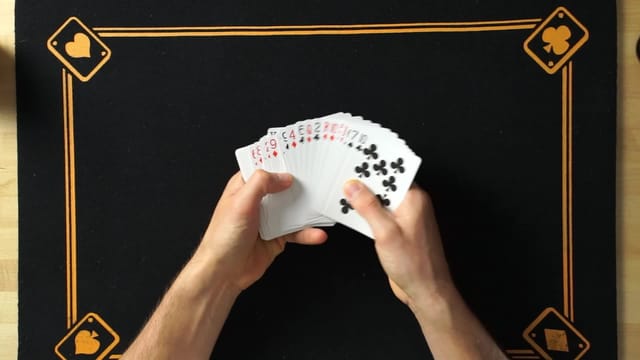
Basic grips: Mechanics, Straddle and Biddle
Holding the deck with intent
The placement of the cards and fingers dictates the moves you can perform afterwards. Julio Ribera dedicates four videos to deck orientation and three families of grips: Mechanics, Straddle, and Biddle.
The explanations are presented with the deck in the left hand and the right hand acting as the supporting hand. Julio explains this choice based on reading the indices and how to follow the moves with a standard deck.
Mechanics or Dealer's Grip
The first grip develops the position of the deck and the contact of the pads. The explanation focuses on the separation from the palm, the role of the thumb, and the distribution of the fingers around the edges.
The goal is to recognize a grip that keeps the deck under control and ready to transition into other positions.
Normal and raised Straddle
The next section modifies the pinky's position and demonstrates the normal and raised variants of the Straddle Grip. It explores the relationship between the height of the deck, finger contact, and the freedom to initiate packet cuts.
Julio suggests getting used to transitioning from Mechanics to Straddle and to raised Straddle, maintaining overall control during the changes.
Biddle Grip
The final explanation introduces the overhead grip used by the right hand. It focuses on a lateral placement to leave room for packets that need to be separated, rather than blocking their path.
You will need a standard deck. This is a lesson in positions and transitions: you can practice each grip separately and then the transitions between them, observing where the cards end up and what space remains free for movement.