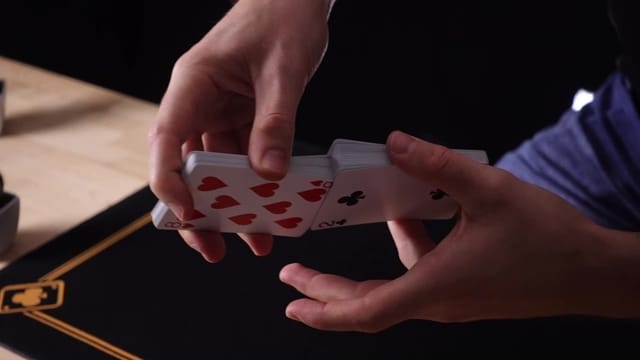
Faro Shuffle: Precise Interweaving and Deck Orientation
The Faro shuffle allows you to interweave the cards one by one with precision. Julio Ribera begins by demonstrating the result with a deck separated into red and black cards, making it easy to see how they alternate upon completing the shuffle.
The explanation covers hand placement and the movement that triggers this interweaving. It also examines why the same deck can respond differently depending on its orientation.
Materials and Grips
Julio recommends a good quality deck. He mentions those manufactured by the U.S. Playing Card Company as an option, alongside others of equivalent quality; he doesn't require purchasing magic products from a single brand.
The tutorial uses the straddle grip, reviews the position of the deck, and demonstrates cutting it into two packets that are as equal as possible. Afterward, the index and pinky finger contacts are adjusted so the packets stay together under the necessary tension.
Finding the Entry Movement
The explanation links corner contact with a subtle forward and lateral sliding movement. The goal is to combine that direction with pressure, rather than trying to force the cards together by pushing.
Julio shows a close-up of the start of the interweave and repeats the movement to highlight its subtle range of motion. He stresses the importance of avoiding excessive force, which can damage the edges.
Keeping the Packets Together
The contact points do more than just hold the cards: they help prevent gaps from opening between the packets. The explanation shows how those gaps disrupt the regularity of the shuffle and returns to the function of the fingers.
Practice must focus on both the direction of movement and the continuity of contact. The goal is to find the adjustment that allows the cards to weave into one another uniformly.
Trying the Other Orientation
The tutorial offers a second hand placement that changes the working orientation of the deck. Julio explains that certain edges make it easier to weave from one side than the other, comparing it to the material he is using.
This difference is part of the practice conditions. The lesson teaches you to recognize it and adapt the orientation, without promising that every deck will respond the same way.
The content is a technical explanation of the Faro shuffle, with a demonstration of the result and two handling options. Practice requires familiarizing yourself with the grips used and adjusting pressure, contact, and direction. The teaching focuses on the interweaving; it does not add routines or card stack calculations here that are not covered in the video.