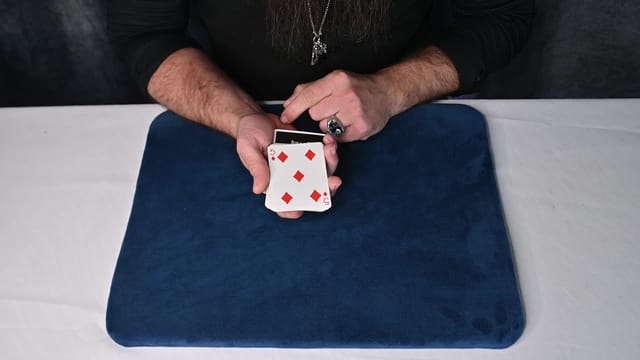
Leandro Furtado's Triumph: Control, Shuffle, and Two Setups
Leandro Furtado's Version
A spectator stops the running cards and remembers a selection. Face-up and face-down cards are seemingly mixed together, and finally, the chosen card appears as the only inverted one. Leandro Furtado demonstrates his version and then explains the control, cover, shuffle, and displays.
The lesson presents two setups. The main one uses three double-backer cards; afterwards, he explains how to substitute them with standard cards. That alternative changes the conditions of the ending and should not be presented as offering the exact same display freedoms.
Controlling the Selection to the Bottom
The explanation begins with the dribble and the return of the card. The position of the index finger is shifted, and a control is executed that Furtado compares to the action of a Cardini color change, adapted to bring the selection to the bottom with the necessary orientation.
The action of the pinky, the jog of the card, and its retrieval while taking the packet are shown. The key detail is to cover before executing the action, rather than trying to mask it after it has already happened.
Furtado repeats the move and discusses how the way the deck is held can reinforce the impression that the card ended up in the center. The actual position is preserved for the next phase.
Turn, Gaze, and Shuffle
With the deck set, a one-handed fan is opened, drawing attention to the face-up cards. The wrist turn is integrated into that gesture and accompanied by looking at the spectator.
The explanation emphasizes attentional cover. It also offers a way to perform the turn beneath the fan if initially it feels more comfortable to maintain greater physical protection.
Next, the packets are interleaved with a Faro shuffle. If you have not mastered it or prefer not to use it, an alternative table shuffle is shown, maintaining control over how the cards are brought together and joined. A perfect Faro is not required as the only way to follow the taught handling.
Setup with Three Double-Backers
In the first option, three double-backers are added to the bottom of a regular deck. The controlled selection and the turn prepare the situation from which cards are shown facing seemingly opposite directions.
Those displays and the squaring of the packets before the revelation are walked through. The construction relies on respecting the initial placement and the sequence of control and turn; it is not simply a matter of shuffling any unprepared deck.
If you choose this option, you will need the three double-backers matching the appearance of the deck. The lesson does not make them a mandatory purchase just to study the effect, as it also teaches the following alternative.
Alternative with Standard Cards
The three double-backers are replaced by three standard cards placed with the indicated orientation. During the displays, they are kept in a controlled zone rather than truly being lost among the rest.
At the end, the entire deck is not turned over as in the other presentation. A spread is performed in the hands that allows the selection to be shown while the white borders help cover the three cards that were not oriented like the rest.
This distinction is essential: the effect appears to sort all the cards, but that setup ends with three cards whose orientation is hidden by the spread. You must maintain the cover and the way of showing, rather than offering a free display that the method itself does not permit.
Materials and Practice
You will need a regular deck; for the main setup, three double-backers; and for the alternative, standard cards with the borders used in the explanation. The preparation of those three cards is arranged before the selection.
The lesson is useful if you want to work on a bottom control, fan cover and gaze, shuffle, and final display under two different conditions. You will need to practice the control, the turn, and the spread, choosing the setup that fits your resources and the ending you wish to present.