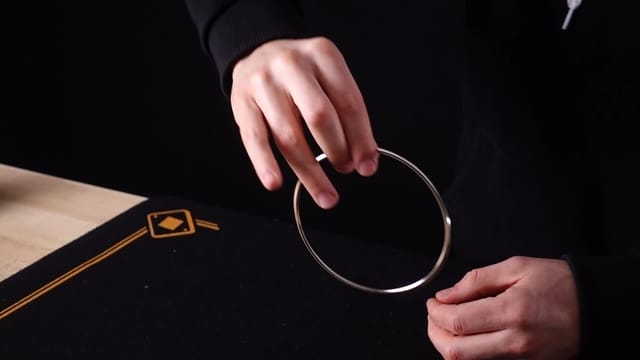
Grips and False Count
How to Handle the Rings Without Looking Clumsy
Imagine standing in front of a friend with four metal rings. You need to show they are all separate, but two are already secretly linked and one has a gap. This is the moment where most beginners get nervous and accidentally show the opening or let the rings clink together. This lesson shows you exactly how to hold the rings so they look solid and how to count them so your audience is convinced they're all separate.
How to Hold the Key Ring and Count to Four
The lesson is split into three specific parts. First, you'll learn the index finger grip, which is what you use for a clean display and moves like the rub link. Next, you'll learn the pinky grip, which is a clever way to make linking the rings much easier. Finally, Julio breaks down the "False Count"—a sequence that lets you show four separate rings even when the work is already done. You'll see the exact finger placements from the performer's view so you can follow along with your own rings.
What’s the Difficulty?
This is a great starting point if you're new to the rings. The grips aren't physically hard, but they require you to be precise about where your fingers sit to hide the gap. The False Count takes the most work because you have to manage the sound the rings make when they hit each other. You can learn the basic finger positions in about ten minutes, but you'll want to spend a few days practicing the count until it looks natural and quiet.
About Julio Ribera
Julio Ribera is a Spanish magician who specializes in making street magic look effortless. He’s taught thousands of students through his online school, Magigram. He’s known for breaking down complex routines into simple, repeatable steps that work in real-world situations.
What's Included
- The Index Finger Grip: How to hold the key ring for clean displays.
- The Pistol Grip: A variation that gives you more control during linking and unlinking.
- The Pinky Finger Grip: Using your pinky to lift the ring and make linking much smoother.
- The Basic Drop Count: A simple way to show four separate rings by dropping them one by one.
- The Advanced False Count: A more deceptive version where you appear to pass the rings from hand to hand.
- The Turning Subtlety: How to show a ring is "solid" by sliding your hand while you turn it.
- Sound Management: How to prevent the rings from clinking and giving away the secret.
Frequently Asked Questions
Do I need a specific set of rings?
These techniques are designed for "Ninja Rings" (smaller linking rings), but the grips and the count will work with almost any set of linking rings you own.
How do I know if I'm hiding the gap correctly?
Julio shows you exactly how to use your thumb and fingers to cover the opening. A good way to check is to practice in front of a mirror or record yourself on your phone to see what the audience sees.
Which grip should I learn first?
Start with the Index Finger Grip. It’s the most versatile and you’ll use it for the majority of the links and unlinks in a standard routine.
Is the advanced count necessary?
Not at all. Julio explains that he often uses the simplest version of the count before starting his routine. The advanced version is there if you want to add an extra layer of deception.