Invisible and Marked Deck: Two-Deck Coincidence
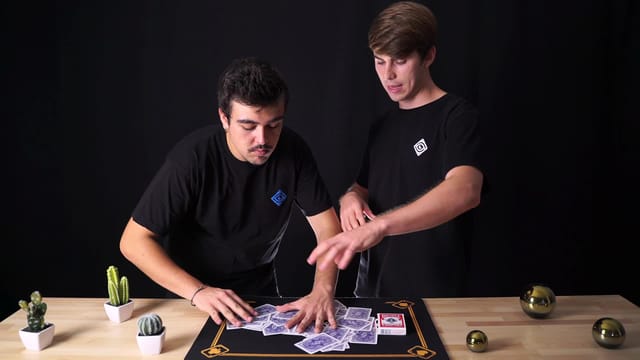
Julio Ribera teaches a two-deck coincidence. The spectator shuffles and spreads the cards of one deck on the table, flips a coin, and keeps the card it lands on. In the other deck, a single reversed card appears that matches the selection. The lesson combines a performance before a participant with an explanation of the tools and the presentation.
The Two Tools
The routine combines an Invisible Deck with a marked deck. The explanation assumes you already know how the Invisible Deck works: that handling is required to perform the revelation and is not covered from scratch in this tutorial.
Julio presents the Phoenix and Copag 310 marked decks. He shows how to read the information provided by their markings and compares the position and visibility of those indicators when spreading or fanning the cards. He also points out that you can use other marked deck models; you are not required to buy both brands.
Building a Seemingly Free Selection
The explanation develops a presentation based on separating responsibilities: the magician handles one deck and the other is left for the spectators. It shows how to give freedom to shuffle, allow the cards to be dealt across the table, and use a coin as a method of selection.
Julio discusses involving multiple people in the shuffle and how to stay uninvolved while the card is being decided. He then links that selection with the handling of the Invisible Deck and the extraction of the card to be used in the revelation.
The Moment of Coincidence
The instruction emphasizes recalling the conditions the audience witnessed before discovering the two cards: who handled each deck, how it was shuffled, and how the decision was made. The climax is built by letting the participant verify the match.
You will need an Invisible Deck, a marked deck, a coin, and a table or surface to spread the cards on. You can find the decks at your local magic shop. Practice handling the Invisible Deck beforehand and reading the markings of the model you use, so you can focus on audience participation and the presentation.