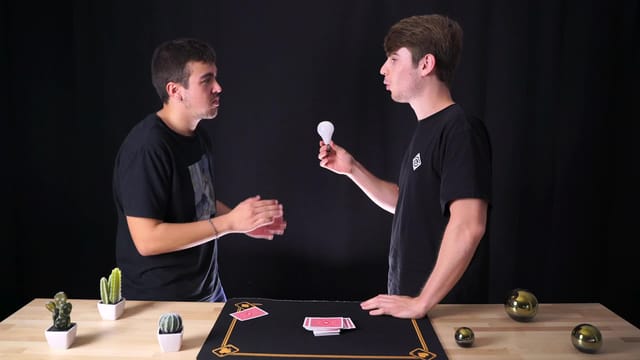
The Light Bulb as a Lie Detector: Force and Routine
A light bulb that is not plugged into an electrical outlet seems to respond to the spectator's answers regarding their card. It lights up or stays off during the questions, acting like a magical lie detector, until the final divination.
Julio Ribera demonstrates this routine and explains the two pillars that support it: a card force and the handling of a magic touch-sensitive light bulb. The lesson devotes a significant portion to the principle of the force, its conditions, and its potential uses beyond this prop.
The Force and the Illusion of Freedom
The explanation introduces the function of a force: creating the impression of a completely free choice while the performer already has the necessary information. A procedure based on a cut and the handling of two packets is developed.
The work isn't just about placing the cards. Julio emphasizes the questions, gestures, and pauses that separate the actions so that the participant builds a clear mental picture of what just happened.
Working After the Spectator Shuffles
The tutorial distinguishes between two scenarios. If it is enough just to know the card that will be used, he explains how to obtain that information with a peek while showing that the deck is mixed. If a specific card is needed for another effect, he develops a way to set it up while removing the jokers.
This second possibility expands the applications of the principle. References to predictions and card transpositions are examples of use; they are not offered as complete explanations of all those other tricks.
Time Misdirection
Julio breaks down the timing between cutting, marking the cut, and taking the card. He analyzes how a question or a presentation element can shift attention and provide a logical motivation for the actions.
He also clarifies the necessary instructions: in this procedure, the participant leaves one packet to the side and does not immediately complete the cut. The coherence of the gestures, the placement of the packets, and the performance intervals are all part of what you will learn.
Using the Light Bulb in the Routine
The explanation shows how to hold the prop and control its illumination through contact with a suitable metallic object, such as the ring worn by the instructor. A coin is also mentioned as a handling option.
You will learn to coordinate the turning on and off of the bulb with questions about the card and the participant's answers. The supposed lie detector belongs to the magical presentation; it is not a real instrument for determining a person's truthfulness.
Materials, Alternatives, and Skill Level
To perform the routine shown, you need a standard deck of cards, a magic touch-sensitive light bulb, and the appropriate metallic object for it to work. You can find this prop at your favorite magic shop. A regular household light bulb cannot replace the function taught in the tutorial.
The force can be studied and performed without the light bulb, using a different patter. The jokers are used in the option of preparing a specific card; the duplicates and envelopes mentioned correspond to examples of other applications, not requirements for this demonstration.
It is an accessible introduction to the force, although it requires practicing your timing and instructions. Julio Ribera is the instructor. The lesson teaches the handling and the reasons behind it, without promising 100% success with every performance or under all circumstances.