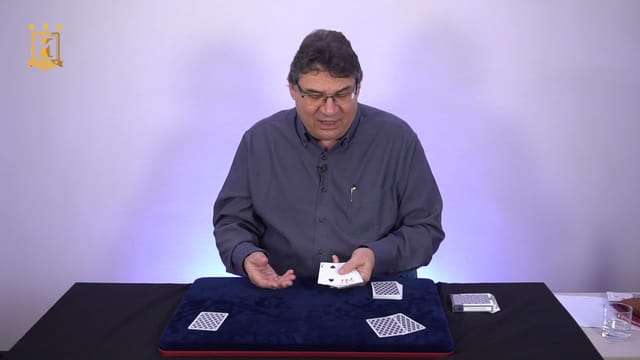
Smart Sleights: Double Lifts, Shuffles, and Changes
Roberto Giobbi defines 'smart sleights' as actions the audience can follow while simultaneously fulfilling a covert technical function that goes unnoticed. Drawing inspiration from a concept linked to Arturo de Ascanio, he explores applications for the double lift, shuffles, and deck switches. The performance and explanation of 'Matching the Cards' bring these resources together into a complete routine.
Recognizing and Studying a Principle
This masterclass encourages focusing on both abstract concepts and manual sleights. A glance, a pause, or a procedure can warrant study even if it doesn't look like a traditional move. Giobbi recommends pausing the footage and taking notes to turn observations into actionable practice.
The core criterion is embedding a secret function within a comprehensible action. This construction is compared to performing hidden work while attention is misdirected elsewhere, and the reasoning behind each gesture is closely examined.
The Double Lift and Partial Shuffle
The first example secures the necessary break for a double lift right within the gesture of taking a card. He covers the push-off, squaring the card back onto the deck, and finding a natural motivation to place it down—such as pointing to a spot or asking the spectator to extend their hand. He also distinguishes between lifting a double and turning it over on the deck, focusing on maintaining the continuity of the action.
The second example preserves a group of cards using an in-jog shuffle and cuts. The explanation breaks down how to keep a smooth hand rhythm, establish the reference point, and link the shuffle with the cuts. The goal is to make the visible procedure look completely natural while secretly maintaining the required stack.
Justifying a Deck Switch
Three ways to justify switching decks mid-performance are discussed: giving away the used deck and needing cards again later, introducing a deck related to a gambling theme, or bringing out an obviously special pack for a different effect. These are structural and presentation strategies; teaching how to manufacture all the mentioned gaffs or stacks is not included.
Matching the Cards: Coincidence, Mistake, and Transformation
The performance begins with a single card set aside and several cards that seem to match it. An unexpected value introduces a pseudo-mistake, which is resolved through the transformation of the remaining cards. Giobbi presents the routine as a take on Dai Vernon's classic and analyzes both its setup and the dramatic logic behind the climax.
Included is a method for building the setup while searching through the cards and transitioning from a previous packet trick. He explains how to leverage a counting action and a shuffle to arrive at the stack. The suggested lead-in tricks are offered as transitional options rather than fully developed routines in this class.
The handling combines a riffle force, the Henry Christ change, a double lift, and a Hindu force with a convincing procedure. The glide and a second deal are discussed as alternatives in one phase. It also examines how to increase the sense of choice, repeat an action to familiarize the audience with it, and reduce movements that prolong a change.
The apparent mistake receives particular attention: whom to show the card to first, how long to wait, and how to avoid overacting. Before the final transformation, Giobbi suggests trying to correct the apparently wrong card. That intention gives a cause to the climax and distinguishes the surprise from a simple display of cards.
Material, Requirements, and Practice
For the technical examples and the routine, you need a standard deck and a surface on which to place the cards. The routine uses pre-arranged value groups; the explanation also provides a setup starting from a shuffled deck. Additional decks are only for the switch strategies and are not required to practice 'Matching the Cards'.
You should already be comfortable with breaks, overhand shuffles, double lifts, and basic force techniques. The class covers refinements and applications, but assumes familiarity with these fundamentals. The Faro shuffle is mentioned as a comparative technical solution, but it is not mandatory for this construction.
As homework, take a trick you already perform and review its handling and mechanics. Look for a visible action that could justify the secret work and test how it impacts the overall flow of your patter.