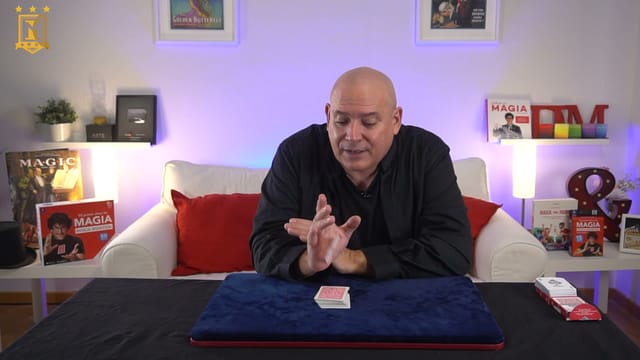
Conditioned Naturalness and Pivot Palm
Willy Monroe delves into conditioned naturalness: aligning the gestures of a secret sleight with those of a normal, everyday action, keeping your handling consistent whether you are burning a move or not. The pivot palm serves as the core exercise to analyze balance, pressure, breathing, and overall hand posture.
Comparing Real and Fake Actions
The explanation kicks off with cuts and deals. We look at what the spectators actually perceive when you genuinely cut or deal, and how to maintain that exact look when handling a secret sleight. Willy also tosses around the term "conditioned normality" to describe this rehearsal process.
It is not just about burning a move. The visible motivation must be crystal clear: squaring the deck, closing the packet, or setting it down on the table. The masterclass encourages you to study these actions clean first, then preserve that same rhythm and visual flow once the sleight is added.
As an application of the second deal, he teaches a presentation where the hand acts like a hound sniffing out a chosen card, finding it at the exact number named by the spectator. The shape of the hand thus plays a direct role in the patter. You will need to control the selection in advance using any method you are already comfortable with.
Pivot Palm and Deck Balance
The core section focuses on the pivot palm while receiving and squaring up the packets. He breaks down how the packets rest between the fingers, the natural tilt of the deck in each hand, and the difference between maintaining proper balance and gripping with a death grip.
Willy contrasts a sequence full of nervous openings and closes with one that requires minimal effort. He walks through the handling in slow motion, showing the connection between the meeting of the hands, the squaring of the packets, and setting the deck down on the table. Breathing is woven naturally into the movement, without forcing a one-size-fits-all timing for everyone.
He also covers how to retain a palmed card: the contact points, the breathing room that lets you relax your hand, and adjusting to your hand size. The teacher demonstrates subtle tweaks in finger pressure to avoid a stiff posture. The goal is to keep the hand looking completely casual.
Other Applications
Demos of the second deal and double lift inspired by Derek Dingle show how a personal handling can match your normal dealing style. He discusses the push-off, the grip, and the flow of the gesture.
The top change provides another great example: the travel path of both hands, the natural gesticulation, and hand relaxation are tied directly to swapping out the card. Gabriel Moreno's table faro and rhythm control are mentioned as study references, though this isn't a comprehensive course on those techniques.
Materials and Prerequisites
All you need is an ordinary deck of cards and a table. You should already be comfortable with basic cuts, dealing, and control work. The mechanics of the palm are covered in depth, but they do require putting in the reps on coordination and pressure; the examples on deals, double lifts, and top changes are easiest to digest if you already have some mileage in card magic.
When practicing, first compare the clean gesture side-by-side with the sleight. Notice what shifts in terms of tension, motivation, and travel path, and tailor the handling to your own hands. The whole point of the class is to master this analytical process and use it to polish your own moves.