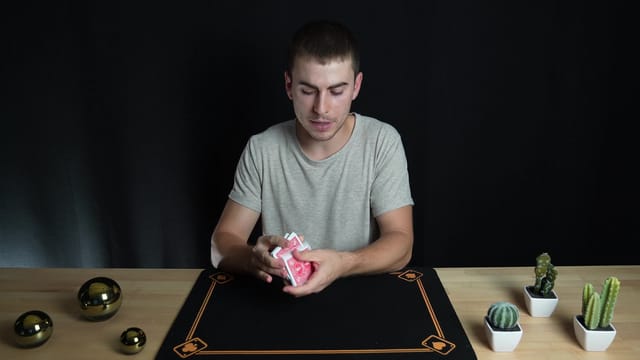
Overhand shuffle: grip and packet withdrawal
The overhand shuffle is a familiar gesture that can serve as the foundation for other card magic handlings. Julio Ribera dedicates this lesson to executing it correctly: how to hold the deck, receive the cards, and pull off small packets with the thumb.
The lesson contains two videos. The first presents the possibilities of the technique and shows examples of controlling a card to various positions. The second develops the grip and the basic shuffle. It is important to distinguish these demonstrations from the advanced applications mentioned: neither every control nor a complete false shuffle system is broken down here.
Why review a basic sleight
Julio explains that habits acquired from playing card games do not always serve as a foundation for more precise technique. The explanation distinguishes between holding the cards by the sides versus pulling them off with the thumb from the back, which is the action to be learned.
The goal is to build a way of shuffling that can be maintained when studying subsequent handlings. Pulling off individual cards, packets, and jogged cards are cited as possibilities, without replacing their specific explanations.
Hand placement and receiving the cards
The tutorial covers holding the deck by the short ends and placing it vertically in the receiving hand. It works on the cupped shape of the hand, the curvature of the fingers, and the role of the index finger as a stop so the cards do not slide forward out of control.
Next, that position is related to the thumb, which remains free to take the cards. The explanation separates the functions of each hand before bringing them together in the shuffling motion.
Withdrawing packets and finishing
You will learn to coordinate the raising and lowering of the hand holding the deck with the withdrawal of small packets. Julio reviews the grip and the thumb's contact point once again so the action does not rely on dropping cards haphazardly.
You need a deck of cards and practice with that coordination. The content provides a handling foundation and explains why it deserves attention even if the move feels familiar. The introduction's examples show its potential; the developed learning focuses on the overhand shuffle and its fundamental supports.