Balloon Prediction
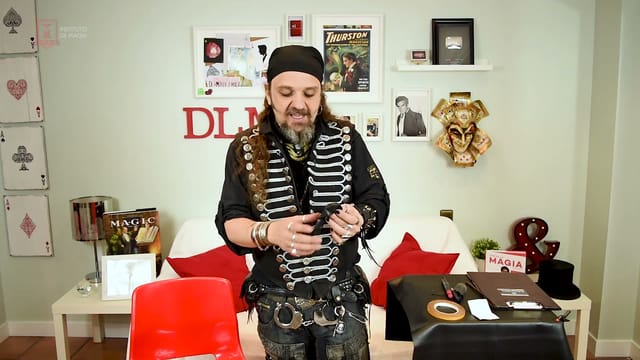
Several spectators build an imaginary journey by choosing a location, a character, their appearance, and a date. In the end, a signed card that appears to have been inside a balloon brings all those choices together. Greca performs the complete effect and explains his handling of the balloon prediction inspired by Barrie Richardson, complete with the nuances he uses in his professional shows.
Preparation and Routine Development
The explanation covers material preparation, preliminary interaction with a participant, and the onstage setup of props. It details managing multiple participants, identifying each helper, and gathering responses without losing the narrative thread.
The handling of the billets, writing materials, and clipboard is studied alongside the gestures and patter accompanying each action. It also explains how to coordinate the spectator verifications, approaching the stage, and the final revelation. A start-to-finish review revisits the sequence and details regarding hand naturalness, cover, and transitions.
Script, Attention, and Presentation
The travel story serves as an example of a prediction with multiple interconnected parts. Greca analyzes how to adapt audience responses, choose equivalent phrasing, and utilize a final kicker that breaks the monotony of repetitive revelations. He recommends crafting your own storyline with interrelated choices, and also suggests creating a comic book character as an alternative presentation angle.
The masterclass examines conversational pacing, the motivation for actions, and audience management. The rehearsal goal is to integrate technical sleight of hand with questions, answers, and volunteer participation while maintaining the flow of the effect.
Materials and Working Conditions
You will need latex balloons, a card, sheets of paper, a clipboard, double-sided tape, a marker, and a pen, plus a prop to pop the balloon. The preparation of these gimmicks is explained in the class. The choice of a blunt object and gesture control for spectator safety are also covered.
The routine is designed for a solo performer without a stage assistant, relying on audience participation. Experience with billet work and palm is recommended, along with verbal coordination and angle control. The format is tailored for parlor and stage; the instructor notes the limitations of performing too close to the audience.