Prologue and Epilogue: Presenting a Poker Routine
Roberto Giobbi analyzes the prologue and epilogue as devices to give a coherent presentation to a trick. The lesson distinguishes between technical, dramatic, and psychological construction, and uses a poker routine to observe how they relate. It concludes with concrete ideas to find themes and openings for one's own repertoire.
Opening and Closing a Trick
The prologue captures attention, introduces the theme, and presents the props. When it opens a performance, it also allows the audience to start getting to know the person performing magic. It can be brief: a question, a line, a gesture, or a prop are enough if they give a reason to care about what comes next.
The epilogue offers a closer and helps remember what happened. Giobbi suggests returning to the initial theme without unnecessarily dragging out the action. He compares this framing to a story told throughout the entire trick: continuous narration requires the spectator to follow both the storyline and the effect at the same time, a difficulty worth keeping in mind when choosing the presentation.
The importance of addressing the audience's intelligence with interesting information and authentic-sounding patter is discussed. The lesson also distinguishes between the theme already contained within an effect and the meaning the performer can add through their presentation.
Thought-Of Card and Royal Flush
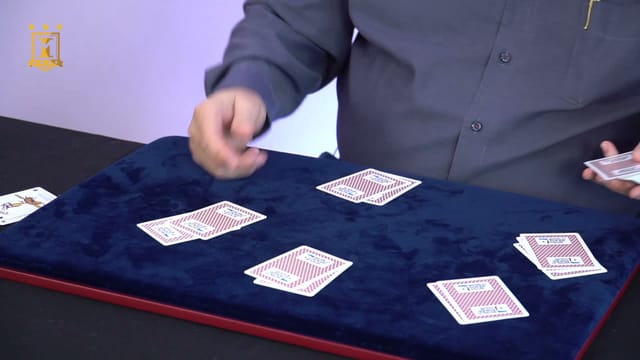
The performance explores how a card sharp might cheat other players. Five poker hands are dealt, and the participant takes one of them, thinks of their highest card, and remembers its position. After gathering and shuffling, they choose which hand they want it to appear in. The climax combines locating the thought-of card with a royal flush; a final line brings back the theme of playing cards.
Giobbi explains a version of 'Subconscious Poker', which he attributes to Joseph K. Schmidt, incorporating an idea by Richard Vollmer to introduce the thought-of card. The analysis covers the set-up, the mathematical principle of the deal, the gathering phase, and the necessary adjustments depending on the named hand. False shuffles and cuts that preserve the useful stack are studied. For certain adjustments, alternatives are offered, including the double cut and the side steal.
The presentation work includes using a themed deck, the removal of the jokers by the participant, and ways to bring clarity to the choice. A practical problem is also addressed: maintaining interest during the dealing of twenty-five cards. The initial proximity of the hands, questions to the audience, and a smooth deal help integrate that procedure into the performance. The final deal with one hand adds another layer of presentation.
Finding Your Own Prologue
Suggestions cover questions, quotes, proverbs, anecdotes, slogans, and book titles. It is recommended to jot down ideas that appear during reading, conversation, or daily life, and select those that fit the trick and the performer's style.
Props can also offer an entrance: a curious box, a card case for two decks, a repertory organizer, or a fold-out catalog from which the audience chooses a trick. The Gozinta Box and other props are shown as presentation examples. The lesson does not explain all the effects that could be performed with them.
Materials and Practice
The poker routine uses a standard 52-card deck with a pre-set stack; the jokers are part of the introduction and are removed before the deal. It is best to have a table or close-up pad with enough room for five hands. A casino or poker-themed deck provides visual context, but it is not a requirement of the method.
The core principle is mathematical, although the presented version incorporates sleight of hand. It is wise to know the deal, the false shuffles and cuts, and to practice your chosen adjustment alternative before performing. The side steal is not mandatory if you use the double cut explained as an option.
As an exercise, take a trick you already know and check if it has a prologue, theme, and epilogue. Look for an opening that sparks interest and a closer that rounds out that idea. The goal is to work on the effect's presentation, keeping your patter brief and relevant.