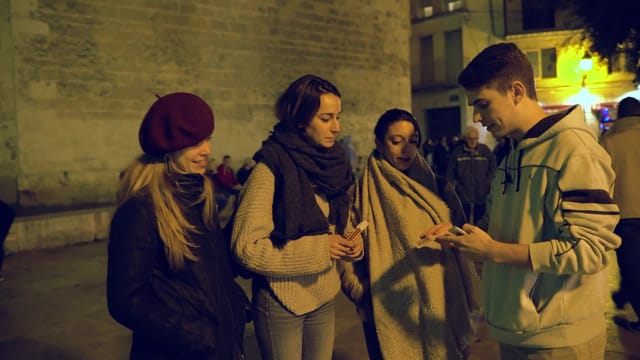
Homemade Rising Card: The Card Rises in the Spectator's Hands
A chosen card, seemingly lost in the deck, rises from the card case while the spectator holds it. Julio Ribera performs the effect with participants and explains a homemade preparation, the complete handling, and options for continuing to use the deck afterwards.
Preparing the Materials
You need an ordinary deck with its case, clear elastic thread, and scissors. The thread used can be found in haberdasheries and sewing supply shops; the instructor shows a reference as an example, without requiring that specific brand or a commercial Rising Card device.
The construction uses two cards and a short section of knotted thread. It explains how to adjust the tension according to the thickness and elasticity of the material, trim the excess, and test its response. Practice allows you to find the proper adjustment; it is not promised that just any thread will work the same without calibration.
The number of cards inside the case is also discussed to leave room for the rise. Cutting the flaps is presented as the instructor's preference; the tutorial itself allows keeping them folded outward, so it is not a mandatory modification.
Card Selection and Handling Preparation
Julio shows ways to shuffle while preserving the setup and how to have a card chosen naturally. While the spectator memorizes it, the necessary break is obtained. Two options are explained: riffling and the Buckle, with the adjustment each one needs in this setup.
The sequence continues by transferring the break during a Swing Cut and inserting the chosen card. The pressure that keeps the assembly stable and the shuffles that can be performed afterward without losing control are examined. It is helpful to recognize Mechanics Grip, Biddle Grip, Swing Cut, and a pinky break.
The Rise in the Spectator's Hands
The explanation covers the orientation when inserting the deck into the case and how to hold it during the handover. Instructions to the participant use the idea of transmitting and releasing energy to coordinate their pressure on the deck with the rising of the card.
Next, it shows how to withdraw it without dragging the cards that accompany the setup. The demonstration with an audience allows you to observe the instructions, the reaction, and the moment when the magician approaches again to take out the card.
Removing the Setup
Options are explained for locating the setup and setting it aside during a natural action: putting the deck away, taking advantage of a deck change, or removing the cards during another justified search. Until doing so, the deck retains its setup; the ability to display it does not equate to having eliminated the gimmick.
Julio connects those moments with the attention on the chosen card and the checking of the case. The goal is to finish in a situation that allows continuing with other routines, without rushing the cleanup during the effect.
Two Finale Variants
The final part uses the same principle to produce a visual appearance during a spread on the table and another during a dribble. These are explained variants of the same setup, in addition to the main presentation in the card case.
It is a complete lesson in construction and handling using ordinary materials. It requires practicing tension, pressure, breaks, and handing it to the participant; the instructor presents a practical opening option, but its smoothness depends on coordinating those elements.