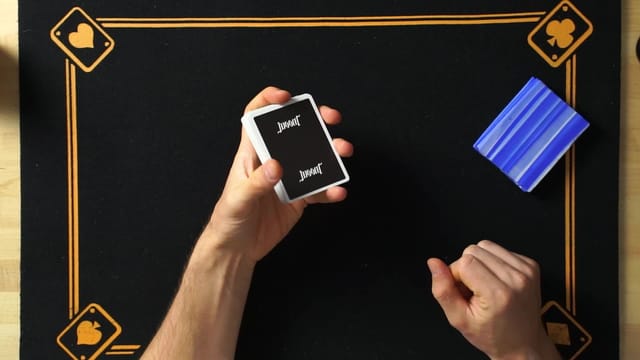
Scissor Cut: Basic Version and Independent Packets
The Scissor Cut is performed with one hand and appears as part of many packet movements. Julio Ribera covers two ways of working on it: the basic cut, which revolves one packet past the other and closes back up, and the version that keeps the packets independent to continue into other flourishes.
Preparing the Opening
The explanation starts from Straddle Grip and also allows you to study the beginning from the high grip. Julio shows how he brings the packet closer to the thumb by repositioning the other fingers, instead of just trying to reach the deck by stretching the thumb.
From there, you work on separating the packet and pivoting it over the index finger. Opening the hand is coordinated with the movement of both packets until one can pass over the other and close. That sequence constitutes the basic scissor cut.
Distinguishing the Basic Cut from Free Packets
The second part addresses an important distinction for linking movements: completing the cut is not the same as being able to keep its packets separated. Julio explains why this independence is useful when the scissor cut is part of a two-handed flourish.
The work focuses on changing the grip on one of the packets while keeping the other free. The explanation uses the support of the pinky and its accompanying fingers to study a position where you can control both elements separately.
Exercises and Closure of the Second Version
Julio suggests practicing placing a packet in a vertical position and recognizing how it is held before adding the rest of the path. Afterwards, he reintegrates that action with the opening and closure.
The lesson reviews both versions: first, the cut that follows the path of the index finger, and then the one that separates the packets, displaces the free one, and brings the cards back together. The goal is to understand what control each provides so you can choose the one needed for the movement you want to link.
Materials and Study Method
You need a deck of cards and familiarity with Straddle Grip. Julio recommends practicing with trainers or with two packets prepared with adhesive tape to reduce the difficulty of keeping the cards together. Cardistry Planks are mentioned as a training option, not as a mandatory purchase.
The explanation suggests working slowly at first and learning the positions and supports separately. It is a foundation that demands coordination: the utility for other cuts comes from being able to control the independent packet, in addition to completing the basic cut.
Julio Ribera teaches this lesson, which includes the opening, pivot, grip exercises, and closure of both versions. No specific magic product is required.