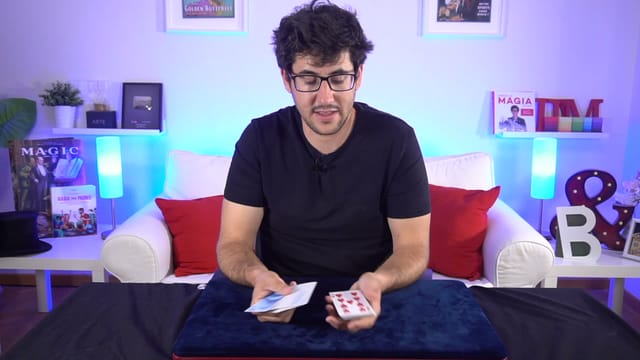
Card Breaks: Breaks, Steps, and the Bottom Buckle
A break lets you keep a reference inside the deck without constantly staring at the cards. Borja Montón breaks down how to get, hold, and recover it with subtle gestures, and how to turn a step back into a break when you need it again. The work wraps up with a full routine featuring two selected cards and the vanishing of the rest of the deck.
Breaks at the Top and in the Middle
The explanation kicks off with a pinky break under the top card. A visible get-ready is compared with a pull-down technique, focusing on the size of the break, thumb pressure, and front angles. The practice goal is to keep the reference with a relaxed hand, without pushing your finger too far in or squaring the packet toward the audience.
The work expands to two cards using a double push-off and to small groups through spreading and squaring the cards. We review how to count and maintain the needed number without making the break get-ready look fishy.
For a card returned in the middle, two alligator handlings are developed: one directly keeps a break when squaring the spread, and another uses an in-jog that can be recovered later. The difference between that jogged card and a two-packet step is explained, along with converting a step into a break. The pause between the return and the control is part of studying pacing.
Transfers, Dribble, and Toss
We work on transferring the pinky break to the thumb area, the pressure that keeps it in place, and adapting the handling to the angles. One application shows how to insert another card at the desired spot without losing the reference. The thumb count and transferring multiple cards are discussed as handling possibilities, without diving into a full counting course here.
Breaks and steps obtained during a dribble and by dropping one packet onto another are also explained. The classic version, Borja's personal preference, and another option during the dribble itself are compared. We study when it's best to hold a break versus when a step lets you drop the cards and recover the reference later.
The Bottom Buckle
The explanation of the buckle starts from the mechanics grip and the relationship between the supports and index finger pressure. You practice separating the bottom card and two cards, with notes on the sensitivity needed to increase the number. The focus is on recognizing what you've broken off and holding it without stiffness, rather than memorizing the exact same pressure for every hand.
Routine with Two Cards and a Handkerchief
The opening performance features two cards remembered by the spectators: they are found under a handkerchief, and at the end, the rest of the deck vanishes. Next, the setup of the sequence, working with the two selections, and coordinating hands, props, and attention are explained.
The law of primary motion is studied through the order of the gestures and how they relate to what the audience follows. We review hand posture, holding the handkerchief, continuity between the revelations, and the moment to show the vanish. There's a fix for continuing if you accidentally break off an extra card, plus a final review of the routine. Repeating it without the cover of the handkerchief is used to show the handling, not as a separate version of the effect.
Material and Setup
You need an ordinary deck of cards and space to practice spreads and packets. For the full routine, you'll need a handkerchief and a jacket with suitable pockets; part of the handling is explained standing up and without a table.
Breaks and buckles are developed from their basic mechanics. To tie into the final application, it helps to already know the double cut, basic two-card controls, and the overhand shuffle: their use is reviewed in the sequence, but all those controls aren't taught from scratch. Practice getting your references, changing your grips, and your patter until you can chat without staring down at the technique.