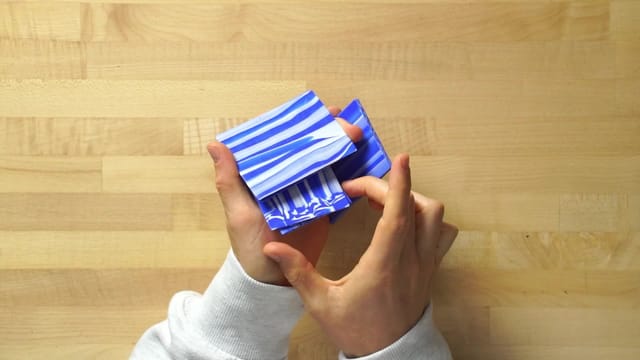
Silk
Why Most Card Cuts Look Static
Most people start cardistry with basic Z-cuts that just sit there. The packets move up and down, but the move feels blocky and "mechanical." It lacks the flow that makes a flourish look like one continuous motion.
The Silk Approach
Silk changes the way you handle the packets by adding rotation and a "flicked" finish. Instead of just holding the cards in a rigid grip, you use a pinky pinch and wrist inversion to let the packets spin. This makes the cards look like they're collapsing on themselves in one smooth, liquid motion.
The most important part is the ending. You don't just close the deck; you use your index and middle fingers to flick the cards into place. This creates a sharp, visual snap that tells your audience the move is over. It turns a standard cut into something that looks professional and feels satisfying to perform. Imagine the deck snapping shut perfectly every time you finish—that's what Silk gives you.
About Julio Ribera
Julio Ribera is a master at making complex-looking moves easy to understand. He’s spent years performing street magic and cardistry for over 1.5 million followers, so he knows exactly where your fingers tend to get stuck. He teaches this move with a focus on "continuity" so it never looks clunky.
How to Master the Silk Move
- How to start from a Strider Grip into a double Z-cut
- The pinky pinch technique that gives the packets freedom to move
- Inverting your wrists to rotate the packets 180 degrees
- Shifting from a vertical grip to a horizontal packet hold
- The index finger "flick" that snaps the deck closed instantly
- Specific tips for keeping the move fluid and continuous
Frequently Asked Questions
Is this move too hard for a beginner?
It’s an intermediate move. If you can already do a basic Z-cut, you can learn this. Julio breaks the finger placements down step-by-step so you won't feel overwhelmed.
Do I need special cards?
Any decent deck of cards works. However, if your cards are very old or sticky, the "flick" at the end won't be as snappy. A relatively fresh deck makes the rotation much easier.
How long does it take to get it smooth?
You’ll understand the mechanics by the end of the 8-minute video. Getting it to look "silky" and fluid usually takes a few days of casual practice while you're hanging out or watching a movie.
What if I have small hands?
The move relies on pivots and gravity rather than big stretches. As long as you can hold a standard deck in a Z-cut, your hand size won't be an issue.