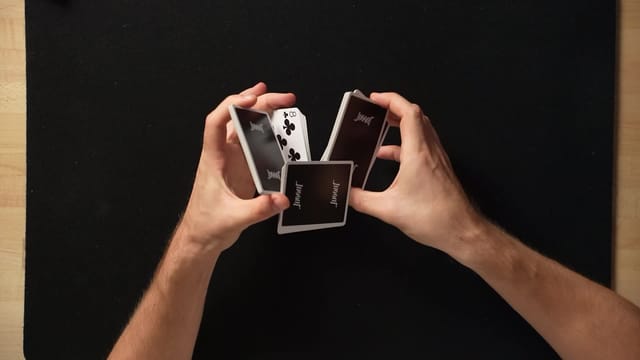
Squeeze a Square
Why Flourishes Often Look Clunky
Most people try to rush through cardistry moves before they understand the mechanics. If you move too fast without the right finger tension, the packets slip, and the "square" looks like a messy pile of cards instead of a sharp geometric shape.
The Secret to Fluid Geometric Cuts
When you fix your grip pressure, the cards look like they’re connected by invisible hinges. Instead of struggling to keep the deck together, you’ll find that the packets almost guide themselves into position. When you pull the square back and it snaps into the final Revolution Cut, it feels like the deck is alive in your hands.
Mastering the Squeeze Flourish
Julio Ribera breaks down this classic flourish into manageable parts. You’ll start with the foundation—the Double Z-cut—and learn exactly where to place your pinky and thumb to anchor the packets. Julio shows you how to move the square forward and back with the "squeezing" motion that gives the move its name. You’ll also learn how to coordinate a Scissor Cut and a Revolution Cut at the same time to finish the move cleanly.
About Julio Ribera
Julio is a digital creator and magician who has taught card magic to millions of people online. He focuses on practical, visual moves that look great on camera and even better in person. He specializes in breaking down complex finger positions so you can learn them without the frustration.
What's Included
- Mastering the Straddle Grip foundation
- The Double Z-cut opening sequence
- Creating the triangle and square shapes
- The forward and back "Squeeze" motion
- Combining the Scissor Cut and Revolution Cut
- Tips for keeping your packets aligned and tidy
Frequently Asked Questions
My hands feel too small for this. Can I still do it?
Cardistry is more about flexibility and finding the right pivot points than hand size. Julio shows you exactly where to place your fingers so you don't have to overstretch your grip.
How do I stop the cards from falling during the rotation?
The secret is in the "pinky anchor." Once you learn how to use your pinky to steady the middle packet while your thumb rotates the top, the rest of the move becomes much more stable.
How long does it take to look smooth?
If you focus on the mechanics first and speed second, you can get the basic flow down in a few practice sessions. The fluidity comes naturally once your fingers memorize the square shape.