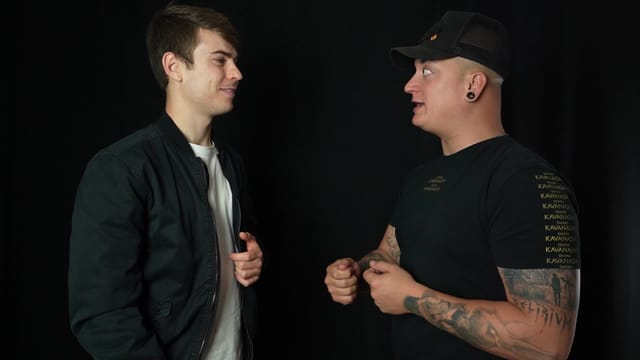
Stage Pickpocketing: The Two Wallets Routine
The performer announces that he will attempt to retrieve his own wallet without the spectator noticing. The presentation concludes with an exchange of expectations and objects that flips the meaning of the challenge. Shado El Mago breaks down this stage pickpocketing routine from setup to climax.
The lesson includes a brief performance intro, the routine performed with a spectator, and its explanation. The subway episode is used as a theatrical framing; the tutorial notes that this section can be swapped out for a different presentation.
Props, Wardrobe, and Setup
The performer's wallet and another item belonging to the spectator—typically their wallet—are used. The explanation mentions the possibility of using a smartphone as an alternative. No specialized magic props are required.
The handling taught relies on a jacket with pockets and how to access them. Shado describes the positioning that feels comfortable to him and discusses what changes if the object is in an inside pocket, outside pocket, or trouser pocket. These locations are not presented as interchangeable positions without adjusting the setup.
The explanation also touches on a false transfer as a handling option that is studied in greater detail in a broader course. Here, it is introduced to establish a possibility, without replacing its thorough learning.
Giving a Reason for Every Action
A core component of the teaching is the patter that accompanies the setup. It covers how to announce the challenge, which object is named, and how to justify touching the jacket and positioning the wallet.
Shado ties this approach to the spectator's receptiveness. The lesson goes beyond just moving an object: it explains how words and physical actions build a scenario that the spectator can follow.
Coordinating Verbal, Visual, and Physical Attention
The tutorial breaks down various forms of attention. Conversation directs interest toward a specific action; the jacket's position influences the field of view; the physical handling alters sensations and the relationship between the objects and the body.
Coordination of these elements within the routine is practiced, with repeated explanations of the precise timing for each phase. The content encourages understanding why an action is placed at a specific moment, rather than merely copying the presentation's posture.
Separating the Setup from the Apparent Moment of the Challenge
Shado uses the concept of the parenthesis of oblivion to explain the time gap between the phases. The difference between what has already been prepared and the moment the spectator believes the attempt begins is studied.
Next, the theatrical episode and the closing line bringing both parties' objects together are developed. The explanation covers various ways to present this segment, including the subway simulation, while keeping the same climax structure.
Practicing the Complete Sequence
It is recommended to practice first with a jacket on a hanger or a stuffed animal, and then with trusted friends or family members. The goal of this practice is to connect placement, contact, attention, and patter, while embracing the possibility of making mistakes during the learning process.
The lesson delivers this complete routine and its foundational concepts. References to other misdirection techniques, sleights, and routines point toward a broader field of study; the three videos focus specifically on the wallet routine and how to build its presentation.