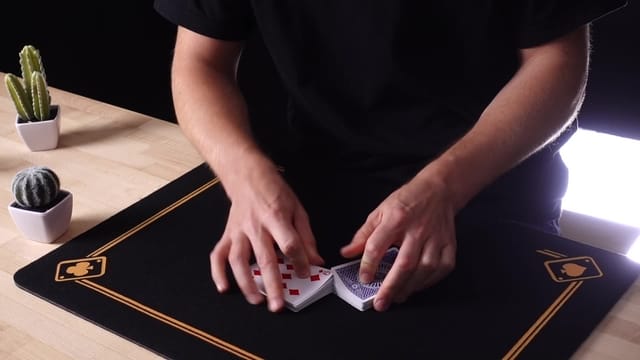
False table riffle shuffle with final cut
The cards are visibly interlaced, the deck appears to be cleanly squared, and a cut concludes the action. Despite that illusion of a shuffle, all the cards retain their order. Julio Ribera presents the result and explains the coordination that makes it possible.
The video breaks down a false table shuffle. The initial demonstration uses a separation of reds and blacks to verify the order and then revisits packet positioning, squaring direction, and the role of the closing cut.
Materials and prior knowledge
You need an ordinary deck and a table. It helps to be familiar with the table riffle shuffle: the explanation begins in that position, splitting the deck and actually interlacing the cards.
The difference lies in how the relationship between the packets is maintained during squaring. No special magic props are required. Learning depends on following the geometry of the blocks and coordinating it with cover.
Understanding the diagonal work
Julio breaks down the direction in which the packets are pushed and contrasts it with a straight square. He explains the placement of the middle fingers and thumbs and how the diagonal movement maintains a useful separation between the blocks.
To make this relationship visible, he demonstrates with one half face up and the other face down. This is a study arrangement that lets you follow each packet; in the covered execution, the cards are face down. This helps you understand why they can be separated later, even though they were genuinely interlaced at first.
Moving to the apparent square
The tutorial identifies the point where the fingers stop contacting only their own packet and begin interacting with both blocks. From that reference, he explains how the orientation changes and how the ability to recover each half is maintained.
Julio revisits the detail from an exposed view and then integrates it with the covered handling. The explanation distinguishes the appearance of a squared deck perceived by the spectator from the actual position of the packets.
Covering the separation and completing the cut
Finger placement during squaring is part of the sleight. He covers how to keep the area where the cards project concealed and how to blend that cover into the next action.
The final cut is presented as the natural continuation of the shuffle. Julio explains its relationship to the preserved separation between the packets and verifies that the deck regains its full order. It is not an added decorative flourish: it is part of the sequence being studied.
Practicing the complete sequence
The explanation reviews the interlace, the diagonal work, the covered square, and the cut to connect their phases. Julio recommends practicing the handling until you master it before incorporating it into routines.
The lesson provides this false shuffle with its cutting finish. Its value lies in combining a convincing image of interlaced cards with an internal organization that preserves the entire stack, without turning the tutorial into a standalone magic routine.