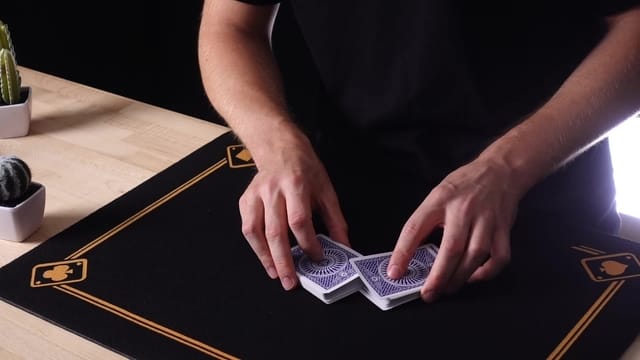
Covered Table Riffle False Shuffle
Julio Ribera demonstrates a table riffle shuffle and checks that the deck remains completely in order. Afterwards, he breaks down the sleight that allows you to simulate the shuffle and restore the packets without altering the position of the cards.
The demonstration uses the separation of reds and blacks and two aces as references to follow the result. The instruction covers the handling of the false shuffle, from the initial division of the deck to the final squaring.
Materials and Starting Shuffle
You need a deck of cards and a table. The explanation starts from the table riffle shuffle, so it is helpful to already be comfortable with dividing the deck into two packets and releasing the cards with the thumbs.
Here, specific work on cover and recovery is added. A gimmicked deck or commercial magic product is not required: the important condition is to understand the order that the blocks must maintain during the handling.
Preparing the Cover
Julio explains what happens to the top card when splitting the deck and how the index finger intervenes to maintain the necessary reference. The tutorial relates this preparation to the position of the packets during the riffle.
He also clarifies which block must remain covered at the top and why that condition allows the technique to continue. The preparation is studied within a cut that, from the outside, must look like a normal division of the deck.
Separating and Restoring the Packets
The explanation continues with the cover created by slightly jogging a card forward. Julio shows how this cover relates to the alignment of the two blocks, their separation, and the return of the packet to its original place.
The sequence is repeated with an exposed view so you can follow the order of the cards. This view helps you understand the difference between what the spectator thinks is happening and the actual organization of the packets during the shuffle.
Adjusting the Squaring and Angles
The tutorial is not limited to indicating the path of the blocks. Julio comments on how much the cover card needs to be displaced and warns that the explanation exaggerates this detail to make it visible.
He also compares the spectator's position when close and looking from above with a more frontal observation. Based on this difference, he explains the tilt adjustment and the role of the hands in covering the recovery. These are presentation conditions that must be practiced alongside the mechanical part.
Bringing the Sequence Together
The video shows the division, the riffle, the cover, the restoration, and the squaring once again as a single sequence. The goal is to preserve the complete stack without losing the appearance of a table shuffle.
The lesson teaches this false shuffle solution and its covering details. To make the most of it, it is helpful to be able to distinguish the exposed handling, which facilitates the study of the covered handling the audience will see, and to check the deck's order during rehearsals.