Telekinesis with Cesaral PK Objects
Apparent movement of objects and mentalism presentation
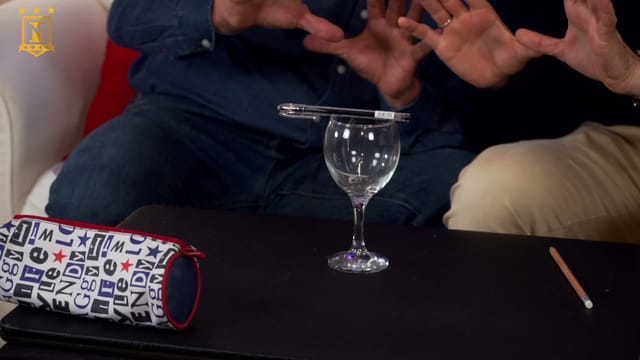
César Alonso, creator of Cesaral, and Borja Montón explore how to integrate telekinesis or PK into a magic presentation: an object appears to move without contact, lose its balance, or react while the spectator concentrates. The class begins with demonstrations of a pencil in Borja's hand and a pen resting on a glass, then breaks down the mechanics, handling, and performance possibilities of the props.
Choosing an object and understanding its conditions
The possibilities of the Cesaral-gimmicked pen, pencil, twig, and paintbrush are compared. Although their appearance is entirely ordinary, they are special props: the explanation does not allow you to perform the same feats with any borrowed pencil, nor does it teach how to manufacture these gimmicks from scratch.
Discussing the design helps clarify what to look for in a practical method: simple setup, the ability to repeat the effect, and movement that can happen without keeping your hands near the object. Other PK systems are mentioned as a reference for comparing conditions and limitations, rather than as complete tutorials for each method.
Preparation, timing, and repeating the effect
César explains the underlying principle and demonstrates how to prepare the material, verify that it is ready, keep it set up, and reuse it. Methods for carrying it in your pocket or a case are reviewed, along with how to weave the setup into casual conversation without drawing unwanted attention.
You will learn how to connect placement and the balance point with the time available to talk, step away, and perform the movement. The differences between the pen's path and the pencil's path are also explained, and how they affect the number of possible repetitions. The goal is to understand the behavior of the specific piece and practice its pacing, rather than relying on a universal timeline for every object.
The instructors analyze when repeating the effect can reinforce the initial impact and how to alter the conditions for a second performance. The magician's distance, audience attention, and clarity of action are all part of this work.
Working in the spectator's hand
The explanation involving the pencil covers hand positioning, support stability, and the instructions given to the participant. It explores how to help them maintain a comfortable posture and how to accompany the movement without making the action look like it depends on the spectator pushing the object.
Borja and César review orientation, the direction of the turn, and the timing window for your cues. These are handling and communication details that are best rehearsed with another person, alongside practicing the gimmick's setup on your own.
The paintbrush as an answer to a question
A performance setup using a paintbrush, plates, dice, and a paper marked with "yes" and "no" is explained. The idea is that the paintbrush's movement appears to answer a question by marking the paint. Support stability, tilting, and the importance of the surface over which it moves are analyzed.
In this recording, the setup is shown without paint, and the paintbrush halts on a textured close-up pad. The intended continuation of the effect is explained, but a full performance of the painted answer is not provided here. This distinction helps evaluate the true scope of the demonstration and what will need to be practiced with the proper materials.
Ideas for developing your own routine
The case provides a recognizable context for the props, and presentations related to writing, drawing, or different historical eras are proposed. The possibility of featuring a child as the supposed cause of the movement is also discussed.
The final section suggests applications of the effect as a timing cue: stopping a deal with a Svengali deck (radio deck), accompanying a PK Touch routine, or coordinating an action with a shadow. These are linking and presentation ideas; the cited card, touch, or shadow routines are not taught in full.
Materials and requirements
To practice the core of the class, you need at least one of the treated Cesaral PK objects and its setup accessory. Add a wine glass or a tumbler for working on a support, and a case if you want to use that presentation. The paintbrush setup also requires plates, two dice, paper, acrylic paint, and a surface that allows for the explained movement. The Svengali deck corresponds solely to an optional application.
Advanced sleight of hand is not required, but you must become familiar with the piece, practice the balance, and coordinate your patter with its response time. The teaching focuses on using and presenting pre-made special material. Physical props are not included, and instructions on how to manufacture them are not taught.