The Magician's Test: Structure and Presentation Analysis
Studying How a Presentation Is Built
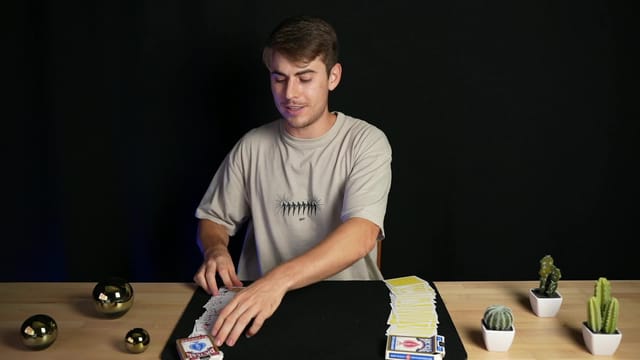
Julio Ribera analyzes a routine that features two participants as candidate magicians. The storyline of an exam connects a color change of the decks with a card coincidence.
The lesson includes three videos: Julio's proposal, Daniel's original presentation, and an analysis lasting about 34 minutes. The commentary revisits clips from both versions to explain the decisions made and compare their effects on the whole.
The core of the learning process is the review: recognizing what function each action serves, looking for alternatives, and connecting the handling to the story experienced by the audience.
Opening with an Ongoing Idea
Julio studies how to begin with a question that sparks curiosity and how to introduce the theme of the test. He then follows that theme throughout the routine so it accompanies the actions.
The comparison highlights the difference between announcing an idea at the beginning and maintaining it as a running thread. The justifications for the questions, the shuffles, and the decisions made by the participants are worked on.
In the adaptation, the tests of knowing the suits, handling the deck, and producing a magical moment give continuity to the presentation before the final climax.
Giving Weight to the Color Change
An extensive part of the analysis is devoted to preparing the perception of the backs and choosing when to show the change.
Julio discusses the use of the card cases, the display during the Hindu shuffle, and the attention directed toward the faces. The study explores how to build a clear initial image without verbally insisting on what is being demonstrated.
The temporal distance between the technical work and the revelation is also analyzed. The participants' involvement is placed within that separation: what they actually do with the deck and what impression the sequence can build.
Attention, Gaze, and Movement
The commentary connects the patter with the direction of the gaze, the first visible movement, and the shift of attention between two people.
Moments of relaxation and actions that provide cover are studied. Julio uses examples from his own handling to explain how to coordinate the body, hands, and words.
The analysis includes work with a break, a double cut, and concealment and lapping resources. The techniques are shown applied to a staging and presentation decision.
Simplifying Without Losing Clarity
Julio compares the card selection from the original proposal with another way of organizing the effect. The reflection focuses on the economy of motion: identifying which steps can be reduced and what the spectator needs to see.
He also asks why a card is shown face up and what changes when the contrast of the backs allows it to be identified differently. Orientation and color are studied as resources to provide clarity and maintain the mystery.
Giving a Role to the Two Participants
The comparison distinguishes a sequence in which two predictions are developed from one in which both participants act more simultaneously.
Julio proposes a crossed coincidence: each person seems to locate the other's card using their own deck. It analyzes how this distribution alters the pacing, the spotlight, and the final image.
The commentary maintains the distinction between what physically happens and how it is presented. Audience participation is part of building the routine.
Recapping and Closing
The lesson examines when to recall decisions and how to relate them to the idea of the test. The recap is framed as a presentation tool to select the moments that support the climax.
The use of neighbor cards to underline the stopping point and the way of revealing the coincidences are also analyzed.
The focus is on giving continuity to what has been narrated and reaching a conclusion that fits that story.
Materials and Prior Knowledge
The study uses two identical-faced decks with contrasting colored backs, their cases, and a table for dealing actions. The color change handling discussed includes lapping work and a setup that permits its use.
It is helpful to know the basis of the double prediction and resources such as the Hindu shuffle, breaks, and the double cut. The teaching concentrates on their application, staging, and the analysis of decisions.
Applying the Process to Your Magic
Julio presents these modifications as proposals that can continue to evolve. He recommends recording yourself, analyzing your own routines, and testing changes before a live audience to observe how they work.
You can use this case study to review your own effects: what you communicate, what each move contributes, how people participate, and what final impression you want to leave.