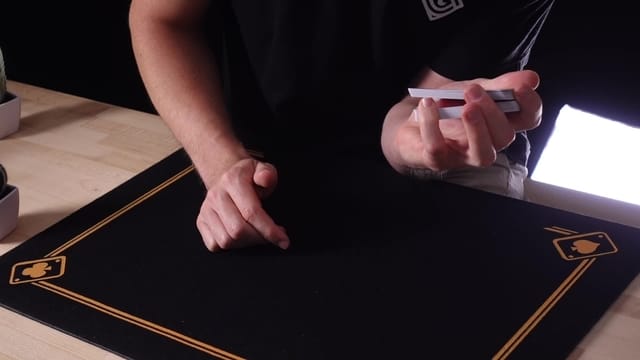
Pinky Break: obtaining and maintaining a break
The Pinky Break allows you to maintain a reference between cards while the deck appears squared. Julio Ribera explains how to obtain that break and hold it so you can use it later in a control or another sleight.
Understanding what is being preserved
The explanation uses a chosen card that returns to the middle of the deck. The work consists of maintaining a small break at the point of interest, allowing you to recognize it without having to search for the card again.
Julio links this reference to later applications, such as cutting to a specific point or setting up other sleights. The lesson focuses on getting and holding the break; the applications serve to understand its usefulness.
Obtaining the break when receiving the card
The first handling deals with returning the card and placing the top packet. We study the contact of the pinky pad and how it accompanies the gathering of the cards to maintain the break.
The explanation pays attention to the size of that space and the look of the squared deck from the front. Julio suggests starting by acknowledging the position and reducing the break as you gain control, in order to maintain the reference with a more subtle handling.
Another entry when squaring a packet
The second option uses a more open placement of the packet and a slight jog that is leveraged when squaring up again. Julio explains how the thumb and pinky are involved in reclaiming the reference.
The objective is to integrate obtaining the break into the action of squaring the deck. We review the path of the packet and the moment the break is established before continuing.
Materials and practice
You need an ordinary deck. The explanation uses Biddle Grip and cutting and squaring actions; it is helpful to be familiar with those positions so you can focus on the pressure and contact of the pinky.
The lesson is taught by Julio Ribera and develops two ways to obtain the Pinky Break, with attention to squaring the deck and keeping the reference. Mentions of the Double Lift and other controls contextualize its usefulness, without turning the video into a complete explanation of all those techniques.