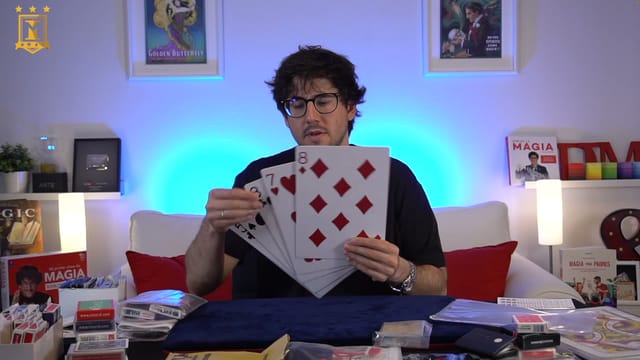
Three Card Monte, special cards and gaffed decks
This class combines the performance and explanation of a Three Card Monte with a guided tour of Borja Montón's card magic props. The goal is to see what special cards and accessories can bring to the table, and to figure out what's actually worth adding to your repertoire. You don't need to buy everything shown: a good chunk of the session is all about comparing possibilities side by side.
Three Card Monte with a kicker finish
The main routine uses three cards and a story about a street hustler. Spectators try to follow the winning card, but every bet leads to a new twist, building up to a final reveal that completely turns the tables on their expectations. First, the full routine is performed, and then the handling is broken down.
The explanation covers the buckle count, the double push-off, a double-card turnover, and keeping your patter perfectly timed with your actions. The core moves are repeated so you can nail the sequence without losing clarity. We also chat about how to adapt the story and carry the small packet in your wallet for impromptu walk-around sessions.
Illustrated cards are shown, but you're encouraged to practice with an Ace of Spades, an Ace of Hearts, and a Joker, or even draw your own on blank cards. Later on, a kid-friendly version pops up using ice cream, spinach, and pizza: this is meant as an example of changing your presentation, not as a second full tutorial.
Special cards and packet tricks
The tour features printed cards, double-facers, double-index cards, flaps, and little mechanical setups for transformations, vanishes, shifting drawings, and killer reveals. We discuss the difference between a standalone prop and a fully fleshed-out routine with proper patter and pacing.
There are brief demos and explanations of a few concepts, like a card penetrating a paperclip and a banknote materializing between two cards. The role of a paperclip in managing a prediction is also highlighted. These segments illustrate specific principles and handlings, rather than serving as an exhaustive masterclass on crafting every single item.
Commercial references include Wow, Insta Print, Twisted, El Constructor, and Inferno, among others. They aren't all treated equally: some are fully demonstrated, others are just described, and for some we peek under the hood at how they work. This class does not provide a complete tutorial for every single commercial routine mentioned. The opening Three Card Monte is the main featured routine of the lesson.
What prepared decks bring to the table
We introduce different deck families and their applications. The marked deck is pitched as a utility tool to gather secret info; the stripper deck is demoed with a card location and a group cut. We also check out the duplicate cards in the Mene-Tekel and the Double Decker format, complete with use cases.
Decks featuring animations, illustrations, or custom backs push the boundaries toward visual and narrative presentations. We check out examples like the Rainbow deck and Card-Toon animations. The aim is to understand what each type of material brings to the table, without promising an exhaustive course on marked decks, stripper decks, or every specialized system.
Choosing material that fits your act
Borja drives home a practical point: a flashy effect will just sit in your drawer if it doesn't have a clear home in your set. He goes over ideas for close-up magic, cocktail parties, and parlor shows, along with accessories outside the deck that punch up the visual impact of a reveal.
The tour includes examples of predictions, transpositions, finder props, and balancing effects. Some are just collector showcases while others are touched on briefly. They aren't presented as ready-to-rock routines you can pull out after watching just once.
We also look at card cases and wallets for storing packets and gimmicks. The condition of certain props leads to a chat about how rubber bands, adhesives, and mechanisms degrade over time or due to heat. You're encouraged to weigh up preservation, setup, and real-world performance against sheer visual punch.
Materials and prerequisites
To practice the main routine, you'll need three cards: the Ace of Spades, the Ace of Hearts, and a Joker, or an equivalent illustrated set. Blank cards are great for drawing your own version. A close-up pad makes following the explanation easier, and a wallet or case is handy for stashing the packet.
You'll want to be fairly comfortable squaring up cards and handling a double lift. The buckle count and core sleights are demonstrated, but they take practice to make your patter and rhythm feel completely natural.
To study the rest of the tour, you definitely don't need to own every single gimmick and deck. If you decide to jam on any of the extra examples, you'll need the specific props and, where applicable, the creator's instructions. Mentions of brands, availability, and shopping experiences reflect the time of recording; they don't guarantee those products are still on the market or included with this lesson.