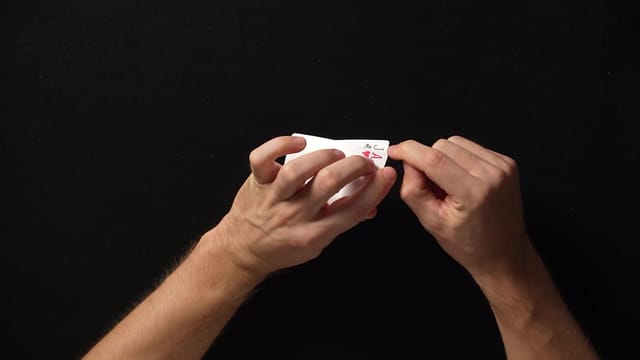
Top Double Lift for Small Packet Magic
Working with few cards focuses the spectator's attention on every move. Julio Ribera explains a way to set up and perform a double lift from the top of a small packet, reducing prior actions to obtain a break between the cards. An example of a transformation demonstrates its utility.
Preparing and turning the set
The tutorial starts with four cards and studies the grip in mechanics grip, the pivot point in the hand, and finger coordination. It explains how to keep the set aligned during the setup, the turn, and the return to the starting position.
Julio compares the depth of the grip and relates finger friction to packet control. Afterward, he shows how to repeat the handling to turn the cards back over, so the explanation covers both the initial presentation and its continuation.
Adapting it to the number of cards
The lesson includes versions with three and five cards, plus an application to the triple lift with a four-card packet. These are adaptations of the same handling principle, explained according to the cards you want to move together.
You need ordinary cards, and it helps to know the idea of the double lift. References to the general study of that technique provide context; here the work concentrates on its application to small packets. You will need to practice pressure, alignment, and the range of motion.