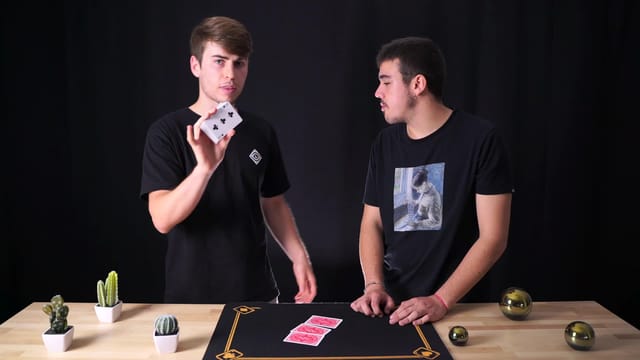
Four-Card Transposition with a Finish in the Spectator's Hands
The spectator shuffles a deck, selects a card and returns it. The magician separates four cards that are shown as different from the selection and sets the rest of the deck aside. After further checks and a choice within the small group, the card that seemed to have stayed in the deck appears.
Julio Ribera teaches the complete construction of this routine and two ways to resolve the ending. The performance shows a direct revelation; the explanation adds an ending in which the transformation takes place between the spectator's hands after several apparent failures.
Setting up the situation with a shuffled deck
The lesson starts with an ordinary deck that the participant may shuffle and examine before choosing. Julio reviews the application of a control using a Swing Cut and Double Undercut, followed by an overhand shuffle, to leave the selection in the required position.
These controls are used as prior knowledge. The tutorial focuses on incorporating them into the routine and maintaining the situation while shuffling; it does not replace complete study of each basic technique.
Having an out if the control fails
Before separating the four cards, Julio introduces a line that gives meaning to the possibility of shuffling again if the selection appears in an unsuitable position.
The explanation links that line to a specific out if the earlier control did not work as expected. It is a tool for constructing and recovering that situation, without promising to solve every execution error.
The extraction and consistency of movement
The lesson studies the grip, finger work and timing of the extraction while displaying the cards. Julio explains how to accompany the handling with a natural movement and maintain the same appearance when the secret action is no longer needed.
He also discusses the hand's orientation relative to the body and the spectators. The instruction includes the cover and framing of the handling; it should be checked from the audience's actual positions, without treating it as a guarantee for every angle.
Showing the packet again
After the deck has been set aside, the routine shows the four cards again. The tutorial develops how to gather the group, its order and the checks that reinforce the impression that the selection is not among them.
The wording of the questions and the gesture involving the last two cards are analysed. The aim is to understand what the spectator should perceive and maintain continuity between what is shown and what happens afterwards.
Two endings according to the choice
Julio explains how to respond to the different positions the participant may name. One possibility leads to the direct revelation of their selection, as seen in the performance.
For the other choices, he develops a longer ending: several apparently failed attempts, a dramatic reason to ask for help and the transformation between the spectator's hands. He also discusses the rest of the audience's participation in that finish.
References to transmitting energy belong to the theatrical premise. The tutorial teaches how to construct the magical moment, without claiming a real transfer of energy or thoughts.
Materials and technical preparation
You need an ordinary deck and space to place four cards and set the rest of the deck aside. No special deck or commercial magic product is required.
Familiarity with a break, Swing Cut, Double Undercut and overhand-shuffle control is helpful. The specific packet handling and the routine's sequences are explained and recapped. Julio Ribera is the instructor; the study combines technique, naturalness, instructions, cover and presentation of the ending.