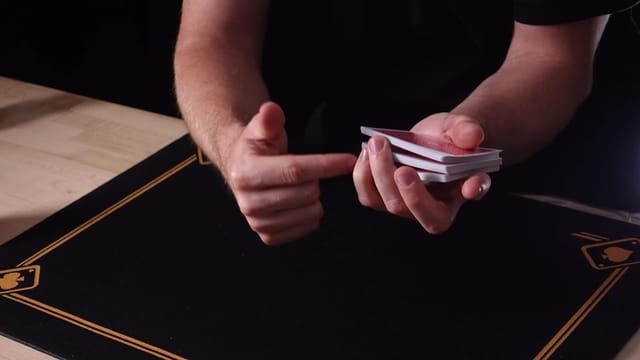
Triple False Cut
How This Cut Keeps Your Deck in Order
If you’ve ever needed to show the cards are "mixed" while keeping a stack or a specific order intact, this is the move you need. The Triple False Cut lets you perform multiple cuts on the table that look completely fair to your audience, but in reality, not a single card changes position. It’s a clean, visual way to handle the deck without ruining your setup.
How It’s Structured
This lesson breaks the move down into the physical handling of the packets. You’ll start by learning how to manage two separations in the deck using your pinky and ring fingers during the initial swing cuts. Once you have the mechanics down, you’ll learn the rhythmic table cuts that finish the sequence and return the deck to its original state.
What’s the Difficulty
This is an intermediate technique. You’ll need to be comfortable holding "breaks" or separations while maneuvering other packets. The hardest part is keeping your hands relaxed so the cuts don't look forced. If you’ve practiced a basic swing cut or a double undercut, you’ll find this feels familiar, but it will take a few sessions of practice to make the table cuts look smooth and natural.
About the Instructor
Julio Ribera is a seasoned performer and online educator known for his practical approach to magic. He focuses on teaching moves that you can actually use in real-world performances, stripping away unnecessary fluff to get straight to the mechanics that work.
What’s Included
- The Triple Cut Mechanics: How to swing cut packets while maintaining two distinct separations.
- Finger Management: Using your pinky and ring fingers to track packet positions without tension.
- Table Sequence: The rhythm of the three-part table cut that restores the deck.
- Control Integration: How to use this as both a false shuffle and a card control.
Frequently Asked Questions
Do I need to be good at cardistry to do this?
Not at all. While it uses a swing cut, it’s a standard magic utility move, not a flourish. If you can hold a deck and move packets, you can learn this.
How do I know if I'm doing it right?
Perform the cut in front of a mirror or record yourself. If the packets look like they are being mixed at random but the deck stays in the original order when you spread it out, you’ve got it.
Should I watch this once or practice alongside it?
Practice along with the video. The timing of the breaks is best learned by feeling the tension in your fingers as you move the packets.
What if I get stuck on the separations?
Focus on your grip. If you find holding two breaks too difficult at first, start by practicing with just one until your hand gets used to the pressure, then add the second break.